THREE IRISH WOLFHOUNDS AND AN AMERICAN STORY
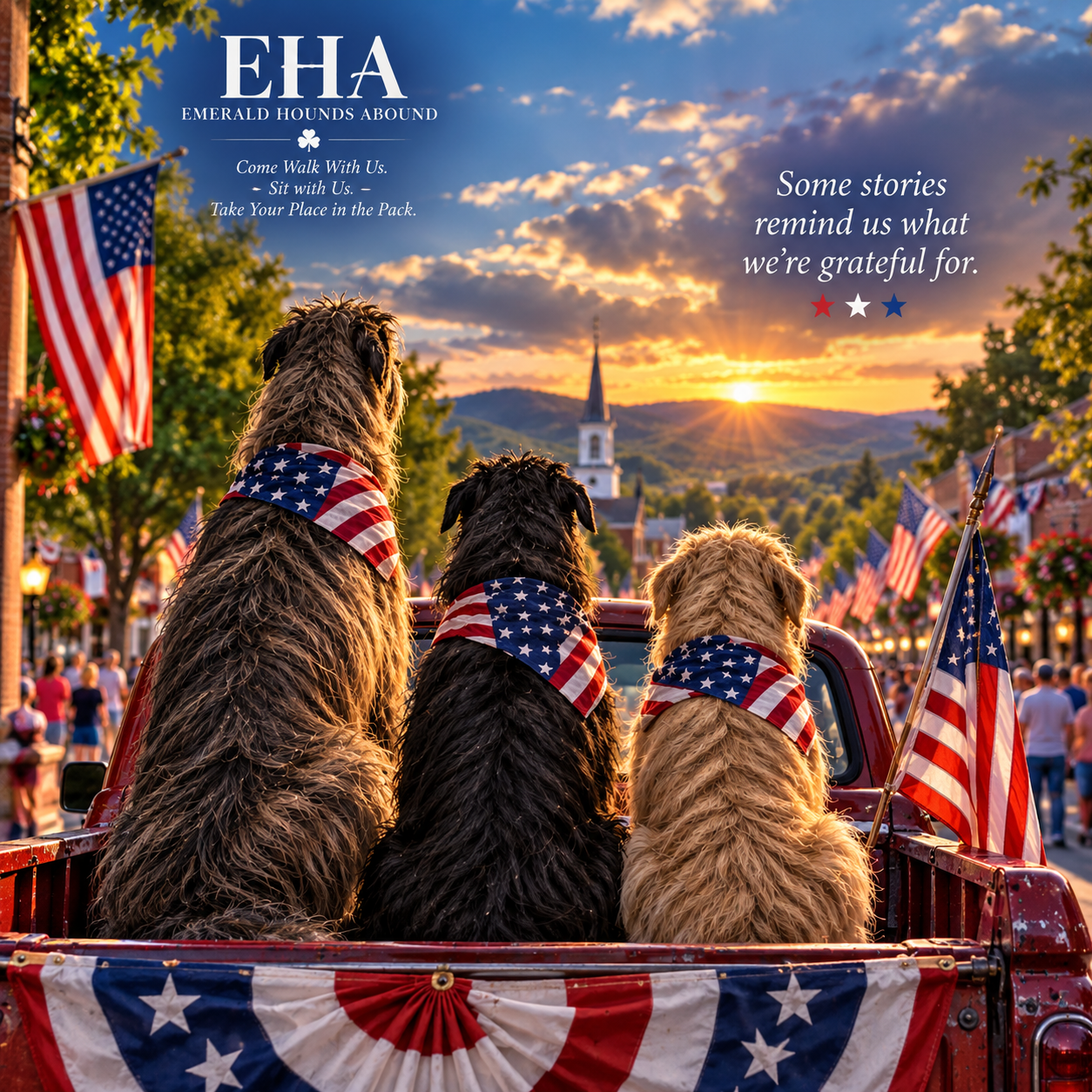
Every family carries a story. Some stories are written in old photographs. Some are tucked into recipe cards, yellowed at the edges and stained with flour. Some are folded carefully into military uniforms stored in cedar chests. Some live in cemeteries, beneath weathered stones and small flags placed by hands that still remember. Some are told around kitchen tables. Some are told on long drives home. Some are passed from one generation to the next without anyone realizing, at the time, that they are passing down anything at all.
Some stories are carried by Wolfhounds.
Two hundred and fifty years since ordinary people placed everything they had, and everything they hoped their children might one day have, on the line for the idea of a new nation.
Two hundred and fifty years since courage stepped out of the shadows and signed its name to history.
Two hundred and fifty years of families. Of sacrifice. Of work. Of faith. Of arguments and healing. Of grief and gratitude. Of people coming from other lands, carrying their old stories with them, and finding room in their hearts for a new one.
Two hundred and fifty years of America being built, protected, challenged, loved, and carried forward by ordinary people who woke up each morning and did what needed to be done. Farmers. Mothers. Fathers. Soldiers. Teachers. Blacksmiths. Nurses. Shopkeepers. Immigrants. Children. Veterans. Neighbors. Families. People whose names may never appear in a history book, but whose lives became part of the nation all the same. History has always belonged to them. It still does.
The morning came softly over the little hollow. Sunlight slipped through the trees. Birds called from the woods. The grass was still wet with dew. Inside the house, coffee was brewing.
Outside, the world was already beginning to look like Independence Day. Flags had appeared on porches, on barns, on fences, and on mailboxes. Some were crisp and new. Some had clearly flown through many summers. Some were small enough for a child to carry. Some were large enough to cover the side of a building.
All of them moved in the same morning breeze. Clover stood in the yard watching one lift and settle again. At seventeen months old, she was still young. But not baby-young. Not anymore. Tall and black. A large splash of white across her chest. A few white-tipped toes. And a white tip at the end of her long tail.
She had begun to understand that the world was larger than the yard, larger than the road, larger than even the places she had already traveled. There were towns. Trails. Parks. People. Stories. So many stories.
Their mom always found them on plaques, on signs, in old buildings, in cemeteries, and in the faces of strangers who stopped to talk about dogs they had loved long ago. Clover did not understand all of it yet. But she was beginning to understand that when their mom stopped to read a sign, she was not only reading words. She was meeting someone. Someone who had been here before. Someone whose story had waited patiently for another person to care enough to stop.
Beside Clover, Hooligan was watching the same flag with complete concentration. He was five months old. Wheaten brindle, with hints of red in his coat. A small white patch beneath his chin. A black-tipped tail. Legs everywhere. Ears still negotiating with gravity. A puppy at the very beginning of everything. The world, to him, was still brand new. Every sound mattered. Every smell deserved investigation. Every road seemed to be going somewhere important.
He watched the flag for a long time. Then he looked at Clover. “Clover?”
“Yeah?”
“Why do people keep hanging flaps on big sticks?”
Clover followed his gaze. The flag lifted again in the breeze. “I don’t think they’re called flaps.”
“What are they called?”
“I think they’re called flags.”
Hooligan looked back at it. The fabric lifted, snapped softly in the breeze, then settled again. “Flap.”
Clover looked at him. “Flag.”
“Flap.”
“Flag.”
Hooligan turned toward her. “Flap, flap, flap, flap.”
“Hooligan.”
His tongue slipped out the side of his mouth. “Flap.”
Clover narrowed her eyes. “Flag.”
“Flaaaaap.”
“Hooligan!”
He pulled his tongue back in, looking enormously pleased with himself.
Clover sighed. Little brothers.
Hooligan looked back at the flag. “Okay. Flag.”
Clover gave him a suspicious look.
He behaved himself for almost three seconds. “Why do people put them outside?”
Clover looked at the flag again. That was a real question. She knew more than Hooligan did. Much more. But she also knew there were things she did not understand yet. That was new too. When she was very small, she had thought knowing a little meant knowing a lot. Now she was beginning to understand that knowing a little mostly showed you how much more there was to learn. “I think...” She paused. “Maybe they help people remember where home is.”
A voice answered from beneath the trees. “That’s a good beginning.”
Clover froze. Her ears lifted. She knew that voice. Or maybe she didn’t. She had never heard it before. But somehow, she knew. Slowly, she turned toward the trees.
Standing in the quiet morning shade was a great gray Irish Wolfhound. Strong. Calm. His eyes were kind. His expression peaceful. Familiar, even though she had never seen him standing in front of her before. His coat was streaked with touches of cream and red. A large splash of white covered his chest. The tip of his long tail was black. There was no drama in his arrival. No thunder. No shining doorway. No announcement. He was simply there, as though love itself had opened a path and allowed him to walk beside them for a while.
Clover stared. Her tail moved first, sweeping once through the wet grass. Then again. Her eyes widened as recognition caught up with what she was seeing. “Shamrock?”
His ears lifted. His own tail began to move. “Hi, Clover.”
For a moment, neither of them seemed quite sure what came next. Shamrock took a few slow steps toward her. Then stopped. Clover watched him. He took another step. Her tail moved faster. That was enough.
Clover got to her feet and walked toward him. They met in the grass. For a moment, they simply stood nose to nose. Clover’s eyes sparkled. So did his. Their tails swept back and forth behind them.
This was Shamrock. Not a story. Not a name she had heard from their mom and dad. Not the brother she had spent her young life knowing without ever having met. Shamrock. Her brother. Right here.
“Hey, guys...” Neither of them moved. Hooligan was still several feet away. His eyes had become enormous. He had actually backed up when Shamrock first stepped out from beneath the trees. He had seen plenty of dogs in his five months of life. He had never seen anything like this one. “Guys?”
Clover finally looked back at him.
Hooligan stared at Shamrock. “Who is this monster dog?”
Clover looked back at the great gray Wolfhound standing in front of her. “My brother.”
Hooligan blinked. “Oh.” Some of the uncertainty left his face. He looked Shamrock up and down. Then up some more. “He’s HUGE.”
Hooligan looked from Clover to Shamrock and back again. “Is he my brother too?”
Shamrock smiled and looked down at the little one who approached him. “Not quite.”
Hooligan waited.
“We’re cousins.”
The puppy thought about that. “What’s a cousin?”
“Your mom and my mom were sisters.”
Hooligan considered this carefully. “So...” He looked at Clover. Then Shamrock. “So the three of us are family?”
Shamrock’s smile deepened. “Yes we are, and that is important.”
Hooligan accepted this immediately. Family was a word he understood. Maybe not in its full depth yet. Maybe not in the way he would understand it someday, after years of walks and storms and long rides and shared adventures. But he understood enough.
Family meant belonging. Family meant you stayed close. Family meant you followed Clover, because Clover usually knew where she was going.
Mostly.
Shamrock laughed. The sound seemed to settle whatever uncertainty Hooligan still had. Shamrock lowered himself into the grass. That was all it took.
Hooligan bounded forward. He stopped just short of Shamrock, sniffed his face, then his shoulder, then moved around him as though there were simply too much dog to investigate from one location. Shamrock stayed where he was, watching him with obvious amusement. Hooligan came around behind him. Stopped. His eyes locked onto Shamrock’s tail. He stared at the black tip. Then looked at his own. Then Shamrock’s. Then his own again. His ears shot up. “Your tail has black on the end too!”
Shamrock looked back at him. “Yes, it does.”
Hooligan hurried around to face him. “Mine does too!”
“I noticed.”
Hooligan looked delighted by this information. Then he glanced at Clover’s long black tail and its white tip. A grin spread across his face. “Black tails are better than white ones.”
Clover groaned. “Hooligan.”
He ignored her completely. “Boys rule and girls drool! Don’t they, Shamrock?”
Clover pretended to be offended, but loved it when her brother felt confident enough to tease her. Shamrock watched the two younger hounds with obvious amusement, the tip of his tail beginning to move. “Puppies,” he murmured, shaking his head, though the warmth in his eyes gave him away.
Suddenly Hooligan stopped bothering his sister, turned to Shamrock and asked, “So, why are you here?”
Shamrock smiled. “America turns two hundred and fifty years old today.”
Hooligan’s eyes widened. “Two hundred and fifty years?”
“Yep.”
“Wow.” He looked Shamrock up and down. “Are you that old too?”
Clover snorted. Shamrock stared at him. “No.”
“Oh.”
Shamrock shook his head, but he was smiling. “It’s a special day, and I wanted to spend it with my family.”
Hooligan looked up at him, his eyes growing wide again. Shamrock caught the look. “And that includes you.” Hooligan softened. His tail began to wag, thumping against Clover, who was standing next to him. Hooligan didn’t notice. He was too busy looking at Shamrock.
For a moment, no one spoke. The morning held them gently. A breeze moved through the trees. Somewhere in the distance, a dog barked. Inside the house, their dad’s voice drifted faintly through an open window as he asked where the cooler was. Their mom answered from another room. Then a cabinet opened. Then closed. Then opened again. Shamrock’s ears perked toward the house. Clover watched him quietly.
“Our mom is getting ready.”
Shamrock’s eyes warmed, his body softened, and he smiled. “Sounds like Mom’s getting ready for an adventure.”
Hooligan’s ears perked up. “Adventure? Are we going somewhere?”
Clover nodded. “Mom packed the cooler.”
Hooligan looked at her. “So?”
“That means we’re going somewhere in the truck.”
Hooligan’s tail started wagging.
The back door opened. Their mom stepped outside. Shamrock’s attention snapped toward her. For a moment, he simply stared. He had known this moment was coming. He had heard her voice through the window. He knew that sooner or later, the door would open and he would see her again. He had expected it to be emotional. He had not expected this.
Perched on her head was an enormous Uncle Sam hat. America-shaped sunglasses covered half her face. Red, white, and blue earrings blinked beneath the brim, matching a necklace that flashed along with them while cheerfully playing They’re Coming to America. Even her sneakers lit up red, white, and blue every time she took a step.
Shamrock stared. He could not believe what she was wearing. And yet, somehow, he absolutely could. The normally composed gray Wolfhound completely lost it. His entire body sprang into the air. All four feet left the ground. He landed, kicked his long legs out behind him, shook his enormous head, and bounded up again, unable to contain himself.
Clover stared at him. She had been watching him closely ever since he’d heard their mom’s voice. Whatever she had expected to happen when he finally saw her, it wasn’t this. But what had walked out of that house was so spectacularly, unmistakably Mom that whatever sadness Shamrock had expected to feel was swept aside by the sheer joy of seeing her exactly as he remembered her. Ridiculous hat. Blinking jewelry. Flashing shoes. All of it. Mom hadn’t changed at all.
Then the back door opened again. Their dad came out behind her with the truck keys in one hand and the cooler in the other. Shamrock’s tail immediately began to wag. Dad. But then Shamrock hesitated. His eyes narrowed. Was that a flag shirt? It was. Shamrock looked down. Crocs? Bright red Crocs? He looked back at their mom. Then at their dad. A flag shirt and bright red Crocs. Well. That was new. Apparently, while he’d been gone, there had been some changes.
Their dad headed toward the truck and began loading up. After setting the cooler inside, he glanced back toward the yard. “Did you grab their toys?”
Their mom stopped. “No! I forgot.” She laughed and shook her head. “You know those toys have to go everywhere with us. They’ll be heartbroken if we leave them home.” She turned toward the pups. “Come on, you two. Grab your stuffies. We’re going for a ride.”
Clover hurried off for Bird while Hooligan bounded after Pig. A moment later, they returned with their treasures and settled back into the grass to wait. Their dad finished loading the truck. “Ready?”
Their mom smiled. “I’ve been waiting all week. I’m excited.” She started toward the passenger side. Because when they were together, their dad drove. That was simply how it was. Their mom navigated. Pointed. Noticed things. Suggested turns. Read signs aloud. And occasionally said, “Can we stop for just a minute?” in a tone that everyone, including the dogs, understood did not always mean a minute.
At the passenger door, their mom turned back toward the yard. The pups were still waiting in the grass with Bird and Pig. Three wolfhounds watched from the grass. To the humans, there were two. Clover and Hooligan. Young. Alive. Waiting for the next adventure. But for one extraordinary day, beneath the Independence Day sky there were three.
One who remembered
. One who was learning.
One who was just beginning.
They climbed into the truck. Hooligan scrambled in with his spotted stuffed pig clenched proudly in his mouth. Clover followed with her own favorite—a ridiculous stuffed bird with a long, wobbly neck and thick rope legs. Wherever the puppies went, apparently, the stuffies went too. Their dad started the engine. Their mom settled into the passenger seat, already looking toward the road ahead. The first flag of the day waved from the porch as they pulled away. Hooligan watched it through the window until the house disappeared behind the trees.
“Shamrock?”
“Hmm?”
“Before. You said the flag was a good beginning.”
Shamrock nodded.
“Beginning of what?”
“A story.”
Hooligan looked around the truck. “What story?”
“Ours.”
Hooligan frowned. “We’re not doing anything.”
Clover looked out the window. “We’re riding in the truck.”
Hooligan looked at her. “We do that all the time.”
“Good point.” Shamrock said while laughing He looked from Clover to Hooligan, then to their mom and dad, his expression warm. “Give it a little time, kiddo. We just left the driveway.”
Clover turned her head toward him. “So today is a story?”
“Yes, and it’s already started.”
“How?”
Shamrock looked from Clover to Hooligan, his expression warm. “Because we’re together—and being together always makes the best stories.”
Shamrock looked at the two pups. “Do you know why we celebrate the Fourth of July?”
Hooligan thought about it. “To have parades?”
Clover looked at him. “Seriously?”
“There are a lot of parades.”
Shamrock laughed. “There are. And fireworks, flags, cookouts and all kinds of celebrations. But there’s a reason all of that happens on July Fourth.”
Hooligan waited.
“On July 4, 1776, a document called the Declaration of Independence was approved. It announced that the thirteen American colonies were no longer going to be ruled by Great Britain. They were declaring themselves free and independent states.”
Clover tilted her head. “They just told Britain they weren’t going to belong to them anymore?”
“In the simplest terms, yes.”
Hooligan looked impressed. “Could they do that?”
Shamrock smiled slightly. “Britain certainly didn’t think so.”
Clover’s ears moved forward. “Then what happened?”
“They had to fight for it. The war had already begun by then, but declaring independence raised the stakes enormously. They were openly rejecting the authority of the British king and declaring that the colonies had the right to govern themselves.”
Hooligan looked thoughtful. “Wasn’t that dangerous?”
“Very.”
Shamrock paused. “Eventually, fifty-six men put their names on the Declaration. They didn’t hide who they were. They signed their names to a document telling one of the most powerful nations in the world that they were breaking away from its rule.”
Clover stared at him. “What would have happened if they lost?”
“Britain considered what they were doing treason. If the Revolution failed, those men could lose their freedom, their homes and property—even their lives. And the consequences could reach their families too.”
Hooligan’s eyes widened. “Their families too?”
Shamrock nodded. “They weren’t only putting themselves in danger.”
Hooligan looked from Shamrock to Clover. “And they signed it anyway?”
“They did.”
Shamrock looked at both pups. “And the last words of the Declaration tell us just how much they were willing to put on the line. They pledged to one another their ‘Lives, their Fortunes and their sacred Honor.’”
Clover was quiet. “They really could have lost everything.”
“They could have.”
The truck rolled down the familiar road. Past woods. Past mailboxes. Past porches waking to the holiday. Past fields where morning mist still clung low to the grass. America was waking up. Not all at once. Not in one grand gesture. But house by house. Family by family. Flag by flag.
On front porches and sidewalks, ordinary people were beginning an extraordinary day. Some were lighting grills, packing chairs, dressing children in red, white, and blue, preparing for parades, and heading to cemeteries. Some were remembering loved ones who had celebrated beside them for decades and were no longer there. Some were simply sitting with coffee, looking at a flag, and thinking of all the years that had led to this one.
Hooligan watched everything. At one farmhouse, an elderly man slowly raised a flag on a weathered pole. When it reached the top, he stepped back, placed one hand over his heart, and stood still. The truck passed quietly.
Hooligan turned to keep watching. “He stopped.”
Clover followed the old man with her eyes. “Yes, he did.”
“Why?”
Clover thought. “Maybe because it mattered.”
She turned toward Shamrock. “Is that close?”
Shamrock gave her an encouraging nod. “Yes, it is. But there’s more.”
The old farmhouse disappeared behind them. “A flag is not only something people fly,” Shamrock said. “It is something they remember.”
Hooligan’s face became very serious. “What do they remember?”
“The people who came before them.”
“The ones who built.”
“The ones who served.”
“The ones who sacrificed.”
“The ones who hoped their children would inherit something worth loving.”
Hooligan was quiet for a moment. “That’s a lot to remember.”
Shamrock smiled softly. “It is. But you don’t have to remember it all at once.”
Clover thought about that. “But people still serve and sacrifice for this country now, don’t they?”
“Yes, they do,” Shamrock answered. “Every day.”
The road widened as they neared town. More flags appeared, bigger ones now—on storefronts, on telephone poles, on fire trucks, and on bicycles. Children carried them. Veterans wore them stitched on hats and jackets. Families had them tucked into picnic baskets and taped to wagon handles. Everywhere Hooligan looked, the colors followed. Red. White. Blue.
Hooligan’s eyes grew wide as he began to understand what Shamrock was telling him. A quiet “Oh” slipped out before he could stop it. He glanced quickly at Shamrock and found only a warm expression waiting for him. Hooligan turned back toward the window. Flags continued to appear along the road as the truck passed. Before he could think about it too much, he looked back at Shamrock.
“Flaps mean a lot of things, don’t they?”
“Flags,” Clover corrected.
“I know.”
Hooligan looked back at Shamrock. “Flags mean a lot of things, don’t they?”
Shamrock looked at him for a moment, a little surprised. “Yeah, Hooligan. They really do.”
“Why does our flag look like that?”
Shamrock followed his gaze. “Every part of it tells something about our country. See the stripes?”
Hooligan looked up. “Red and white.”
“There are thirteen of them. One for each of the thirteen original colonies—the same colonies that declared their independence in 1776.”
Clover looked toward the blue field. “And the stars?”
“Fifty. One for every state in America today.”
Hooligan stared up at the flag. “So it has America when it started...”
Clover looked at the stars. “And America now.”
Shamrock smiled. “Exactly.”
Clover kept looking at the flag. “What about the colors?”
“They have meaning too. Red stands for courage and bravery. White for purity and innocence. And blue for vigilance, perseverance and justice.”
Hooligan tilted his head. “What’s vigilance?”
“Staying watchful. Paying attention. Being ready to protect something important.”
Hooligan nodded slowly. “I do that.”
Clover looked at him. “You bark at leaves.”
“They could be dangerous.”
Shamrock laughed.
As Dad slowed the truck for town, Mom lowered the windows. Clover immediately shoved her head outside, stretching her long neck into the warm summer air. Hooligan squeezed in beside her, pushing until there was just enough room for his head too. Shamrock watched them for a moment before joining in, wedging his enormous gray head between the two younger hounds.
Three Wolfhound heads now competed for one open window. The wind rushed over their faces, pulling at their whiskers and sending their ears flapping wildly behind them. Clover lifted her nose into it. Hooligan’s eyes grew wide with delight. Shamrock closed his eyes for a moment and let the warm air roll over him. Their mom turned from the front seat and caught sight of the two young hounds crowded together at the window. She laughed. “Silly puppers!”
She nudged their dad. “Look, Dad—they’re flying!”
Hooligan’s eyes grew even wider. “I’M FLYING!” he shouted.
Just then one of Shamrock’s enormous ears whipped forward in the wind and smacked Hooligan across the face. Hooligan sputtered, then shouted happily over the rushing air, “WE’RE ALL FLYING!” he yelled even louder.
Shamrock laughed. Then he went still for just a moment. Silly puppers! They’re flying. How long had it been since he’d heard those words? He closed his eyes and pushed his face back into the warm rushing air. For a few more moments, Shamrock wasn’t remembering what it had felt like. He was right there with them.
The town was already alive when they arrived. Main Street had dressed itself for America’s birthday. Bunting hung from old brick buildings. Flower baskets overflowed from lampposts. The local fire department had polished its engines until they gleamed. Families lined the sidewalks with folding chairs and blankets. Children darted between adults, their hands sticky from some treat they had clearly acquired before anyone’s breakfast standards had been consulted. An older couple sat beneath the shade of a maple tree, holding hands. A group of teenagers tried very hard to look casual while clearly enjoying the day more than they intended to admit. Volunteers moved through the crowd, checking on people, adjusting banners, helping older residents find good places to sit. The whole town felt expectant. As though everyone had quietly agreed to be part of the same memory.
Their dad found a parking spot beneath a tree. Their mom looked down Main Street and smiled. “Oh, I love this.”
Their dad laughed. “You haven't even gotten out of the truck yet.”
“I don't need to. Look at it.”
He looked down the street, at the crowd of people and the decorations. “Yeah,” he said, smiling. “This is pretty great.”
The three wolfhounds stepped out into the holiday. Immediately, people noticed them. Irish Wolfhounds tend to make quiet entrances impossible. Children stared. Adults smiled. Someone whispered, “Look at the size of those dogs.” A little girl asked if she could pet Clover. Their mom said yes. Clover lowered her head gently and allowed herself to be admired, which she accepted with considerable grace.
Hooligan watched the little girl pet Clover. “She knows how to make little kids smile.”
“She does.”
Hooligan looked at him. “Will I know how to do that? Is that something Wolfhounds are good at?”
Shamrock lowered his head toward him. “I think making people smile is one of the things we’re especially good at. And you’re already doing it.”
Hooligan seemed surprised. “I am?”
Shamrock laughed. “You made that little girl smile before she even touched Clover.”
Hooligan looked back at the child, who was now telling her father that Clover was “like a horse but softer.” His chest lifted a little. He sat just a bit taller as he watched the little girl and her father walk away, the tip of his tail wagging.
A bell rang somewhere down the street. Conversations began to soften. Children hurried back to their families. Someone called, “It’s starting!” At the far end of Main Street, the parade appeared. First came the color guard. Every American flag was carried with dignity. The crowd stood. Hats came off. Hands found hearts. Voices became still.
The three wolfhounds watched. No one spoke. Even Hooligan did not ask a question. Some moments explain themselves only by being honored. The flags passed slowly. The morning breeze moved them gently. Clover felt something shift inside her. Not understanding, exactly. Not yet. But recognition. The kind of recognition that comes before words.
Only after the color guard had moved farther down Main Street did Hooligan speak. “Everybody got quiet.”
Shamrock lowered his head toward Hooligan. “Yes, they did.”
“Why?”
“Because some things deserve more than our noise.”
Hooligan thought about this. “I liked the quiet.”
Clover moved a little closer beside him. “So did I.”
Behind the color guard came veterans. Some walked. Some rode. Some leaned on canes. Some waved from old military vehicles beside children and grandchildren. The applause that rose from the sidewalk was not wild. It was warmer than that. More careful. More grateful.
Hooligan watched them pass. “They helped protect the story?”
Shamrock gave him a slow nod. “Yes, they did.” His voice softened. “And I think they’d be glad to know you stopped long enough to notice.”
The puppy did not smile this time. He simply watched. The marching band followed. Trumpets caught the morning sun. Drums rolled through the street. Children cheered. Firefighters waved from a polished engine. Scouts marched with solemn faces and oversized backpacks. Classic cars gleamed. The town librarian waved from a decorated convertible. The historical society carried a banner. The church choir sang from a wagon lined with bunting. Every group was different. Every group belonged.
Hooligan looked from one to another. “So many people do so many things.”
Shamrock watched the different groups pass, his tail moving slowly behind him. “They do.”
Hooligan looked up at him. “How do they all know what to do?”
Shamrock chuckled softly. “They don’t always.”
Clover looked at him. “They just find the place where they can help.”
“Some protect.”
“Some teach.”
“Some heal.”
“Some build.”
“Some grow food.”
“Some raise children.”
“Some preserve stories.”
“Some simply try to leave their little corner of the world better than they found it.”
Clover looked at the people lining Main Street. “Ordinary people.”
Shamrock’s ears lifted with pride. “Exactly. Good job, Clover.”
He gave his sister a gentle shoulder bump, pleased that she had found the answer herself.
The parade rolled on. The flags lifted again in the breeze. All along Main Street, red, white, and blue rose together. Hooligan looked up. “They’re all waving.”
Shamrock followed the waving flags with his eyes. “Yes, they are.”
“There’s an old saying people have shared for many years.”
Clover looked at him. “What does it say?”
Shamrock’s eyes stayed on the flags. “The American flag does not fly because the wind moves it... it flies with the last breath of each soldier who died protecting it.”
The three wolfhounds stood in silence, watching the flags. No one added anything. No one needed to. The wind carried the moment down Main Street. And for a while, the celebration felt very still.
Then a child laughed. A drumline started again. A firefighter waved. A toddler dropped his tiny flag, immediately picked it up, and shook it proudly as though he had meant to do that all along. Life resumed. That was part of it too. Remembering. Then continuing.
As the crowd slowly began to move again, Hooligan noticed another flag hanging outside the historical society building. It wasn’t red, white, and blue. It was green, white, and orange. He stopped walking. “Clover?”
“Yeah?”
“That flag looks different.”
Clover studied it for a moment. “I think... that’s the Irish flag.” She turned toward Shamrock. “Am I right?”
Shamrock’s ears lifted with quiet pride. “Yes, you are.”
Clover caught the approval in his face and stood a little taller. Hooligan looked from one flag to the other. “Why are they together?”
Shamrock watched both flags dancing in the same summer breeze. “Because sometimes two stories belong together. Our story began in Ireland.”
Hooligan looked toward the green, white, and orange flag. “A long time ago?”
Shamrock smiled. “A very long time ago.”
“How long?”
“Long enough that nobody can agree on every detail.”
Hooligan’s ears perked. “Really?”
“Really.”
Shamrock looked toward the flag again. “But we know this much. For hundreds of years, our family ran across the rolling green hills.”
“We ran beneath the shadows of castles.”
“We walked beside royalty.”
“We watched over common folk.”
“Farmers.”
“Shepherds.”
“Families.”
“We belonged to Ireland.”
“And Ireland will always be part of who we are.”
Hooligan listened quietly. “Then how did we get here?”
“The Irish came to America.”
“They crossed the ocean because they believed they could build a better life for themselves, and for the families they hoped would come after them.”
“They brought what they loved with them.”
“Their faith.”
“Their traditions.”
“Their stories.”
“And they brought us.”
“As the Irish became part of America’s story—so did the Irish Wolfhound.”
Clover looked toward the people walking through town. “So we came from Ireland, but we found another home.”
Shamrock gave a slow nod. “Yes, we did.” He looked around at the families celebrating Independence Day.
“Our family wasn’t the only one.”
“People came here from countries all over the world.”
“They came with hope.”
“They came looking for opportunity.”
“They came to build better lives.”
“And together they helped build America.”
For a long moment, the three wolfhounds watched the two flags dancing in the same breeze.
Ireland. America. The beginning of one story—and the next chapter of another.
“Do you remember asking if I was your brother this morning?”
Hooligan nodded. “You said you were my cousin.”
“I did. Remember how we talked about being a family this morning?”
Hooligan’s eyes brightened. “Yes, I do!”
Shamrock smiled. “Good.” He looked around at the people filling the street. Families laughing together. Children waving tiny flags. Veterans talking with young parents. Neighbors greeting one another. “Families can be wonderfully different.”
“Different mothers.”
“Different fathers.”
“Different stories.”
“Different places where they began.”
“They brought all of those things with them.”
“Their languages.”
“Their traditions.”
“Their hopes.”
“They never stopped being part of where they came from. When they chose to build their lives here, they became part of the American family too.”
Clover looked around at the celebration. “So everyone keeps part of where they came from... and becomes part of something bigger?”
Shamrock moved closer to her. “Yes. That’s one of America’s greatest gifts—that people from many beginnings can become one family.”
Hooligan thought about that for a long moment. Then one of his ears popped up. “So, if all these people are part of my American family...”
Clover looked sideways at him. “Oh no...”
Hooligan ignored her. “When I turn one next February, does that mean everyone gets me a birthday present?”
Clover sighed. “I knew that’s where this was going.”
Shamrock laughed, his shoulders moving with it. “I don’t think that’s quite how it works.”
Hooligan frowned. “Not even treats?”
Shamrock tipped his head apologetically. “I’m afraid not.”
The puppy considered this carefully and grinned. “I bet our mom will make up the difference.”
Clover laughed. “That part is probably true.”
The three of them walked together for another few steps. Clover, who had brought her toy with her when she left the truck earlier, had Bird dangling from her mouth as she moved with her brothers down the street—his ridiculous neck swinging with every step.
Shamrock glanced at the toy and slowed. “You know, that used to be mine.”
Clover stopped and placed her beloved toy on the ground gently. She looked down at Bird, then back at him. “Yours?”
His ears lifted. “My favorite one. He went everywhere with me.”
Clover studied the battered bird as though seeing him for the first time. “Do you want him back?”
Shamrock’s expression softened. He leaned gently against his little sister. “No. I had my time with him. He’s yours now.”
Clover picked Bird back up and fell into step beside Shamrock, walking just a little closer than before. As they continued, Hooligan looked back up at the two flags dancing together in the summer breeze. The green, white, and orange. The red, white, and blue. Side by side.
Hooligan looked at Shamrock. “So, we’re Irish—and American.”
Shamrock answered without hesitation. “Yes, we are.”
Hooligan smiled. “I think that’s something to be proud of.”
Shamrock’s gaze followed the American flag as it lifted in the breeze. “So do I.”
When the parade ended, no one seemed eager to leave. The celebration simply changed shape. Music faded into conversation. Children compared candy. Neighbors crossed the street to greet one another. The town green filled with blankets, coolers, lawn chairs, and families settling beneath the shade of old trees.
Their mom and dad wandered toward the historical society table. Of course they did. Old photographs were displayed beneath a small canopy. The town as it had looked fifty years ago. A hundred. More. Main Street before the pavement. A schoolhouse. A church picnic. A line of men standing proudly beside a fire wagon. A class of children in stiff collars and serious faces.
Their mom leaned close. “I wonder what their stories were.”
Their dad looked beside her. “Probably more interesting than they ever imagined.”
The three wolfhounds looked too. Black-and-white faces stared back from another time. Hooligan studied them. “They look like regular people.”
Shamrock glanced from the old photographs to Hooligan. “Yes, they were.”
“Then why are they on the table?”
Clover answered slowly. “Because regular people matter.” She glanced toward Shamrock. “Right?”
Shamrock’s eyes warmed. “Yes. Regular people matter very much.”
The puppy looked back at the photographs. “They didn’t know we’d be looking at them today.”
Shamrock settled beside him. “No. They were just living. Every generation thinks that’s all it’s doing.”
“Living.”
“Working.”
“Loving.”
“Worrying.”
“Trying.”
Shamrock looked down at Hooligan. Hooligan wasn’t looking at the photographs anymore. Across the green, a little girl was walking beside her mother with an ice cream cone in one hand. The scoop had begun to lean dangerously to one side. Hooligan stared at it.
Shamrock waited. “Hooligan.”
Nothing. The little girl took another lick. The ice cream wobbled. Hooligan leaned forward.
“Hooligan.” One ear turned toward Shamrock. His eyes stayed on the cone.
Clover followed his stare. “Are you waiting for her ice cream to fall?”
“Maybe.”
Clover looked back at the cone.
The scoop wobbled again. She leaned closer to Hooligan. “If it falls off, it’s mine.”
Hooligan’s head snapped toward her. “What? No! I saw it first.”
“Doesn’t matter. I’m faster than you.”
“No, you’re not.”
“Yes, I am.”
“I’m closer.”
“I have longer legs.”
Hooligan looked down at his own legs. “I’m still growing.”
Clover grinned. “Then you’d better grow faster.”
The scoop tipped farther. Both puppies froze. Their heads slowly turned toward the little girl.
Shamrock looked from Hooligan—to Clover—then to the ice cream cone. “PUPPIES!”
Both heads whipped around. “What?”
Shamrock stared at them.
Clover tried to look innocent.
Hooligan glanced back at the cone. “I’m listening.”
Shamrock raised an eyebrow. “You’re watching ice cream.”
Hooligan thought about that. “I can do both.” The scoop wobbled again. Hooligan and Clover both turned. Shamrock sighed.
Hooligan looked back at him. “Okay. I can’t do both.”
Shamrock shook his head, trying not to laugh. “As I was saying, someday, someone looks back and realizes they were part of history.”
Hooligan looked around at the town green. At the children, the parents, the veterans, the volunteers, and the families. “Are these people history too?”
“They are making it right now.”
Clover watched a little girl carry a plate of pie to an elderly woman seated alone in the shade. The woman smiled. The little girl smiled back. No one announced the kindness. No one applauded. It happened quietly, like most good things do. Clover watched the little girl return to her family. “I think America is made of moments like that.”
Shamrock leaned lightly against his sister. “I think you’re beginning to see her, Clover.”
The afternoon drifted gently. They ate. They rested. They listened to music on the green. Hooligan watched two children become instant friends over a game of catch. Clover leaned into the hands of strangers who wanted to meet her. Their mom read every sign. Their dad stood beside her, patient and interested in a way that meant he would later claim he was only waiting, even though everyone knew better. The day warmed. Then softened.
Eventually, their mom looked toward the road. “There’s one more place I want to stop before we head to the river.”
Their dad nodded. “I figured.”
She smiled. “You knew?”
“I always know.”
She laughed. “I make it easy.”
He smiled. “You do.”
They loaded back into the truck. The town slipped behind them. The road narrowed again. Houses gave way to trees. Trees gave way to stone walls, fields, and glimpses of the Hudson Valley rolling beyond them.
The next stop was quieter. No parade. No music. No crowd. Just a historic site set beside an open field. An old stone wall. A weathered monument. A few plaques. A small cluster of American flags. The kind of place many people might pass without realizing how much of the country’s story had once stood there, uncertain and unfinished. Their mom stepped out slowly. “I’m glad we came.”
Their dad looked across the field. “Me too.”
A young family stood near the monument, their children taking turns reading names from the stone. An elderly volunteer gently brushed leaves away from the base of a marker before straightening a small flag that had begun to lean. Near the edge of the field, an older man stood with both hands resting on a cane. He was not reading. He seemed to be remembering history from his own family. He gently wiped his eyes with the back of his hand. No one disturbed him.
The three wolfhounds followed their mom to one of the plaques. She leaned in. “I’ll read this one.”
Their dad stood beside her. The hounds settled close. Their mom read aloud. “Here, ordinary men answered an extraordinary call.”
“Farmers left their fields.”
“Blacksmiths left their forges.”
“Merchants closed their shops.”
“Teachers, laborers, fathers, sons, neighbors and friends stood together in defense of a dream that had not yet become a nation.”
“Many never returned home.”
“Their sacrifice helped secure the liberties that generations of Americans continue to cherish.”
When she finished, the field was quiet. A hawk circled overhead. The grass moved in the breeze.
Hooligan looked around. “It doesn’t look like a battlefield.”
Shamrock responded. “No, it doesn’t, not anymore. Now it looks like a simple meadow.”
“So where was the fighting?”
Shamrock looked across the quiet ground. “Right here. You’re looking at where the battle happened all of those years ago.”
Hooligan stood there taking in what he had just been told. “It’s peaceful now—quiet and calm.”
“Yes,” Shamrock answered gently. “And that is a great gift. The land heals. But it does not ask us to forget.”
Clover turned back toward the plaque Mom had just read aloud. “They were ordinary people.”
Shamrock moved closer beside her. “Yes, they were.”
Clover was quiet for a moment, thinking about what their mom had just read. “They had families. Work waiting. Fears. Dreams.”
She looked across the quiet field and continued. “They laughed. Worried—probably more than we’ll ever know. Wondered if courage would be enough.”
Shamrock smiled gently and nodded in agreement. “They were not born as names in history books. They became part of history because, when the moment came, they answered.”
No one moved for a while. The silence felt respectful. Shamrock looked out across the quiet battlefield. “The Revolutionary War had already begun more than a year before the Declaration of Independence.”
Hooligan looked at him. “But I thought they didn’t declare independence until July Fourth?”
“They didn’t. The first fighting happened on April 19, 1775, at Lexington and Concord in Massachusetts.”
Clover looked confused. “Then what were they fighting for?”
“At first, many of the colonists weren’t fighting to become a separate country. They were fighting against things they believed Britain was doing wrong and to protect rights they believed they already had.”
Hooligan thought about that. “So they were still British?”
“They were. Independence came later. As the fighting continued, more and more people began to believe that fixing things with Britain wasn’t going to be enough.”
Clover looked at him. “So they decided to leave.”
“They decided to become their own country,” Shamrock said. “And by July of 1776, they took that enormous step. They formally declared that the thirteen colonies were no longer under British rule. They were free and independent states.”
Hooligan looked back across the battlefield. “But they had already been fighting for more than a year.”
“They had.” Shamrock looked across the land with him. “One of those first battles happened at a place called Concord. At a bridge there, colonists fought against British soldiers. Years later, a writer named Ralph Waldo Emerson wrote about that moment and gave it a name that people still remember.”
Hooligan’s ears lifted. “What did he call it?”
Shamrock smiled. “The shot heard round the world.”
Hooligan looked puzzled. “The whole world heard it?”
Clover glanced at him. “I don’t think he meant they actually heard it.”
Shamrock laughed. “No. He meant that what happened there became much bigger than one gunshot or one battle. A struggle that began in thirteen colonies eventually helped create a new country—and changed history far beyond this land.”
Clover looked across the battlefield again. “And then came the Declaration.”
“More than a year later.”
Hooligan was quiet for a moment. “So the Declaration didn’t start the war.”
Shamrock smiled. “No. It told Britain—and the rest of the world—what the colonies had now decided they were fighting for.” Eventually, they started back toward the truck.
Hooligan stopped. Something buzzed past his nose. His head turned. Another one zipped by. Then another. Hooligan followed them through the grass, fascinated. Clover noticed what her little brother was chasing—sky raisins! She wasn't about to let Hooligan have all the good snacks. She bounded after one. Snap! Missed. Another buzzed past. Clover jumped again. Snap!
“CLOVER—NO!” Mom's voice carried across the field. Another bee darted in front of Clover. She sprang after it. Snap! “NO—LEAVE IT!” Mom was already running across the field to catch up with them. Clover finally stopped and looked back at her. “Those aren’t regular sky raisins,” Mom told her when she reached them. “They are spicy sky raisins, and those bite back.”
Shamrock chuckled. “Listen to Mom. Trust me. I found out the hard way.”
Hooligan's eyes widened. “You ate one?”
Shamrock said nothing. One eyebrow lifted. That was answer enough. “Yeah. You should probably stay away from porcupines, too.”
Clover stared at him. Hooligan stared at him. Hooligan gave the bees one last curious glance before turning around to head back to the parking lot. Clover joined him. Shamrock watched the two young Wolfhounds for a moment, then followed after them. Shamrock chuckled softly. “Puppies” Together, Mom and the three Wolfhounds headed across the field toward Dad and the waiting truck. Dad opened the doors, and the pups climbed into the back with Shamrock. Mom settled into the passenger seat, and moments later they were on their way.
Soon, the road carried them nearer to the river. A sign appeared ahead. West Point. Their mom noticed it first. “West Point.”
Their dad glanced toward the Hudson. “Still serving.”
Their mom looked toward the sign, thoughtful. “If West Point had fallen...” She let the sentence hang for a moment. “...the Revolution might have had a very different ending.”
Their dad was quiet. “A lot depended on the people who stood there.”
The truck continued forward. In the back, Hooligan watched the sign disappear behind them. “What’s West Point?”
Clover thought carefully. “I think... it’s where soldiers learn how to become leaders.” She turned to her brother. “Is that right?”
Shamrock’s ears lifted approvingly. “Yes, it is. You’ve been paying attention. Good job.” Shamrock’s gaze followed the river.
“Every generation asks something extraordinary of a few.”
“Some answer that call.”
“They leave their homes.”
“They leave their families.”
“They accept burdens most people will never carry.”
“Not because they love war, but because they love peace.”
Clover listened closely.
“For more than two centuries, West Point has prepared men and women to carry that responsibility.”
“Some came home.”
“Some did not.”
“Every one of them deserves our gratitude.”
Shamrock’s gaze followed the river. “But West Point was not only a place where soldiers learned to lead.”
Clover looked toward the water. “The river?”
Shamrock nodded toward the water. “Yes.”
Hooligan pressed closer to the window. He turned his head to look at the river too. (((SMEAR))) His nose slid across the glass, leaving a trail of slime across the window.
Clover groaned. “Ewww! Watch what you’re doing.”
Hooligan admired his masterpiece. “Mom calls it my puppy nose art and says it’s to be cherished.”
Clover sighed. “Our mom is a terrible influence.”
Shamrock glanced at the masterpiece on the glass. “Well, I suppose you’ve left your mark on the Hudson Valley.”
Hooligan looked pleased. “I have?”
Clover sighed. “Please don’t encourage him.”
Shamrock’s eyes twinkled. “I wouldn’t dream of it.” Shamrock continued. “The Hudson was one of the most important waterways in the colonies. If the British controlled it, they could divide the colonies and stop people, supplies, and soldiers from moving freely.”
“How did they stop them?”
Shamrock was quiet for a moment. “They built a chain.”
“A chain?”
“Here at West Point, across the Hudson River, a massive iron chain was stretched from shore to shore. It was supported by logs and built to stop British ships from moving up the river.”
Clover looked amazed. “They stopped a whole fleet with a chain?”
Shamrock’s eyes twinkled. “Apparently, the people here weren’t afraid to think big.”
Clover looked back at the river. “They stopped more than ships.”
Shamrock’s voice grew thoughtful. “They stopped momentum. They showed that when something precious is worth protecting, people will find a way. The chain helped keep the Hudson out of British hands, and West Point became one of the most important defensive positions of the Revolution.”
Hooligan looked back at the river. “So the people here were protecting the future?”
Shamrock gave Hooligan a slow nod. “Yes. You’re trying to understand what it meant, not just what happened. I see that.”
Hooligan looked at Shamrock sheepishly and quietly said, “I think I’d like to thank all of those people who were so brave.”
Shamrock lowered his head toward him. “So would I. I think remembering them is one way we do.”
The truck continued beside the Hudson. The river moved steadily in the afternoon light.
It had carried explorers.
Soldiers.
Immigrants.
Cargo.
Dreams.
Heartbreak.
Hope.
It had watched America struggle into existence. It had watched her grow. And now, on her 250th birthday, it was waiting to carry her celebration.
By the time they reached the riverfront, evening had begun settling over the water. The day softened at the edges.
Families had gathered along the shoreline. Blankets covered the grass. Children ran with glow sticks. Couples sat shoulder to shoulder in folding chairs. A veteran and his wife sat near the water, their hands resting together between them. A little girl slept against her father’s shoulder, a tiny American flag still held loosely in one hand. Out on the Hudson, the ships waited.
Hooligan stopped walking and his spotted pig toy dangled from his mouth. He stared.
There were boats everywhere. Military vessels. Private boats. Tall ships with masts rising into the evening sky. Small family boats bobbing in the current. Some had come from nearby. Some from other states. Some had come from countries all around the world.
They had come to celebrate America’s 250th birthday—and they came dressed for the occasion.
Their own flags flew proudly from their vessels, alongside the red, white, and blue of the United States. Flags flew from sterns. Bunting draped along rails. Signal flags danced high above decks. Flags from around the world moved in the evening breeze, alongside American flags everywhere they looked. Red, white, and blue moved across the water. Other colors moved with them. In the fading light, the colors seemed to go on forever.
Hooligan’s mouth fell open, Pig slipped from his mouth and fell to the ground. He didn’t notice. His eyes grew wide as he tried to take it all in. “So many,” he whispered.
Clover stepped closer beside him. She had never seen anything like it either. For a moment, neither of them spoke.
Hooligan’s eyes grew a little watery. His lower lip trembled just slightly. He looked from one boat to the next, as though there could possibly be a way to count them all. “There are so many boats,” he whispered again.
Clover leaned gently against him. “I know.” Her own eyes were shining. “It’s beautiful.”
Hooligan nodded, but he seemed unable to find any more words.
Shamrock moved closer. He gently nuzzled the top of Hooligan’s head, then rested his muzzle against him for a moment. His voice was soft. “Some birthdays matter to more than the family celebrating them.”
Hooligan looked up at him.
Clover watched the ships. “It isn’t just America celebrating.”
Shamrock’s gaze stayed on the flags moving across the water. “No, it isn’t.” He looked at the two younger hounds. “Tonight, the whole world came to celebrate with her.”
A ship sounded its horn. Deep. Steady. Proud. Then another answered. Then another. Their voices rolled across the river and echoed against the hills. Hooligan leaned closer to Clover. “Are they talking?”
Clover’s ears lifted as another horn sounded across the river. “I think maybe they’re saying happy birthday.”
Shamrock’s ears lifted too. “I think that’s exactly what they’re saying.”
The lights on the ships began to glow. One by one. Deck lights. Mast lights. Strings of tiny bulbs. Lanterns. Reflections shimmered across the Hudson until the river looked as though the stars had come down early to wait for the fireworks.
Hooligan whispered, “The sky fell into the water.”
Clover stared at the shimmering reflection, then turned toward Shamrock. “That’s actually kind of true.”
Amusement warmed Shamrock’s face. “Tonight, I think the sky and the river both wanted to be part of the story.”
Clover was quiet for a moment. “I think I understand more than I did this morning,” she said softly.
Shamrock smiled. “We talked about a lot of important things today.” He smiled at her. “And I watched you think about every one of them.” He leaned gently against her. “You’ve learned a lot today, Clover. I’m proud of you.”
Hooligan looked between them. “What about me?”
Shamrock turned to him. “What about you, Hooligan?”
“I learned a lot about the flaps.”
Shamrock laughed. “You sure did.”
Hooligan stood a little taller.
Shamrock smiled. “Good job, kiddo.”
Shamrock glanced around. “Where’s your Pig?”
Hooligan froze. “PIG?!” He spun around and tore off across the grass to find it before he forgot again.
Shamrock and Clover watched him go. “Puppies,” they said together.
A voice came over the loudspeaker. The fireworks would begin soon. People settled. Children hurried back to blankets. Parents gathered little ones close. Friends lifted their phones. Couples leaned together. The crowd grew quieter, not because anyone asked them to, but because everyone seemed to feel the moment arriving. Then the countdown began.
Ten. Nine. Eight.
Hooligan looked around. “Why are they counting?”
Clover watched the people joining in. “I think because they’re starting together.”
Shamrock’s tail swept slowly behind him. “Some moments are too special to begin alone.”
Seven. Six. Five.
Voices rose from the riverbank. Children, parents, grandparents, veterans, visitors, neighbors, and strangers. All counting as one. Four. Three. Two. One.
For one perfect heartbeat, the entire shoreline held its breath. Then the first firework rose from the river. A golden trail climbed into the darkening sky. Higher. Higher. Higher. Then it bloomed. Gold spilled across the night. Its reflection opened beneath it on the Hudson, another firework born upside down in the water.
The crowd cheered. The ships answered with horns. Hooligan jumped straight up. Clover laughed. “I wasn’t expecting that either.”
Shamrock chuckled as both younger hounds recovered. “Good. I’d hate to be the only one pretending that didn’t startle me.”
Hooligan’s ears went in several emotional directions at once. “The sky exploded.”
Shamrock’s eyebrows lifted. “Yes, it did—beautifully.”
Hooligan looked back toward the sky. “Why do we have fireworks on America’s birthday?”
Shamrock looked toward the sky. “Because Americans have been celebrating independence with fireworks almost from the beginning.”
Hooligan looked at him. “Really?”
“Really. On America’s very first birthday, people celebrated with bells, bonfires, cannon fire and fireworks.” Another shell rose. Red. Then white. Then blue.
Hooligan watched the colors open above them. “Red, white and blue. Like the flag.”
They opened one after another over the river, each one mirrored below in ripples of light. The Hudson became a second sky. Hooligan stood completely still now, all puppy motion forgotten. “The river has stars.”
Shamrock followed the shimmering reflections across the water. “That’s certainly what it looks like tonight!” More fireworks followed. Silver cascades. Golden palms. Red bursts that seemed to hang in the air longer than they should. Blue stars scattered across the sky like handfuls of sapphires. White chrysanthemums bloomed over ships from near and far. Every color appeared twice. Once above. Once below.
And between them stood America.
On the shore.
On the water.
In the families watching.
In the flags waving.
In the soldiers remembered.
In the children laughing.
In the old songs carried quietly from one generation to the next.
Shamrock turned to Clover and Hooligan. “Look around.”
They did.
At the fireworks.
At the ships.
At the flags.
At the people along the riverbank.
At their mom and dad sitting just behind them, shoulder to shoulder, watching the sky with the same quiet wonder they had carried all day.
Shamrock’s voice was gentle. “That’s America.”
Clover did not answer right away. She was watching everything now.
Not just the fireworks.
The people.
The river.
The families.
The flags.
The ships.
The memory.
The gratitude.
The firework show continued. The finale began slowly. Then built. One firework became ten. Ten became twenty. The sky filled with color. The river filled with light. The ships sounded their horns again. Children cheered. Parents laughed. Flags lifted in the evening breeze. All along the Hudson, every American flag seemed to rise at once.
Hooligan noticed them. With understanding in his eyes, he glanced at Shamrock. Shamrock smiled and gave the smallest nod. Hooligan lowered his head for just a moment. Then he looked back toward the river as another firework burst overhead. Suddenly, the finale thundered across the sky.
Red.
White.
Blue.
Gold.
Silver.
The Hudson shook with light. Then, just when it seemed the show had ended, one final firework rose alone. It climbed higher than the others. Quietly. Gracefully. Almost as if it had been waiting. Then it opened over the river in brilliant emerald green. For one breath, the sky was Ireland. The river was America. And both were home. No one said anything. No one needed to. The green light shimmered across the Hudson, then faded into smoke and stars.
The crowd cheered. The ships answered. Children clapped. Families began gathering their things. But Clover did not move. She was looking at Shamrock. He was not watching the sky.
He was watching them.
Clover.
Hooligan.
Their mom.
Their dad.
His family.
His smile was peaceful. Wise. Full of gratitude.
Clover watched Shamrock for a moment. Something about him was different now. “You’re not coming home with us, are you?”
Shamrock did not answer. He didn’t need to. Clover slowly sat down, the sadness showing plainly on her face.
Hooligan looked from Clover to Shamrock. “I don’t want today to end.”
A soft whine escaped him as he curled up close beside Clover for comfort. Hooligan’s nose had begun to run. Shamrock walked over and lowered himself beside them so he wasn’t standing above them. When he spoke, his voice was soft. “Mom learned something important on her tenth birthday.”
Clover lifted her eyes to him.
“She learned that all good things eventually come to an end.”
Shamrock paused. “Today is America’s 250th birthday. And now you two are learning the same thing.”
Hooligan sniffed.
“It hurts when something wonderful ends. That’s because it mattered.”
He let that sit with them for a moment. Then, very softly, he said: “Don’t cry because it’s over. Smile because it happened.”
For a long while, none of them spoke. The kind of silence that does not feel empty. The kind that feels full.
Eventually, the families along the river began making their way toward the parking areas. Their mom stood, gathered the blanket and said, “Come on gang, it’s time to head home.” Their dad collected the last of their things. The three wolfhounds followed slowly. No one hurried. The river remained behind them, still carrying reflections of ship lights and fading smoke. Families walked together toward parking lots and sidewalks and side streets. Children were carried in their parents’ arms. Flags continued moving gently in the night breeze.
Shamrock walked with his family, but a few steps behind. His attention had shifted to their mom. Clover noticed. She didn’t say anything. Their mom looked tired now. Happy. The kind of tired that comes after a very full day.
When they reached the truck, their mom began taking off the things she had worn for the holiday. The red, white, and blue that had been with her since morning slowly disappeared. She turned off the blinking earrings. The little blue and white stars and the red rockets went dark. She removed the matching necklace that had played They’re Coming to America throughout the day. Then the America-shaped sunglasses she had worn even during the fireworks because they glowed in the dark. Then the enormous Uncle Sam hat. Finally, she reached down and pressed the buttons on her sneakers. The red, white, and blue lights stopped blinking. Their mom placed the last of her holiday things inside the truck.
Shamrock had watched every bit of the holiday disappear piece by piece. He looked at her for a long moment. He knew. This was the part he had been trying not to think about all day. The celebration was ending.
So was his time with them.
Their mom stepped onto the running board. Something made her hesitate. She turned and looked back toward the river. Toward the place where they had just spent the last few hours. Toward the water still carrying the reflections of the ships. Toward the flags. Toward the night. She stood there for a moment. Then she smiled. She turned back toward the truck, sat down in the cab, and closed the door. The inside of the truck was dark.
Their mom would later tell them that she wasn't sure why she had stopped. She had simply felt something.
The evening air had suddenly seemed... full.
Not crowded.
Just... complete.
For the briefest moment, she had the unmistakable feeling that someone she loved had spent the day walking beside them.
Then the feeling was gone.
Outside, Shamrock was still standing there. His eyes remained fixed on their mom. Hooligan had already climbed into the back. Clover stood beside the open door. She looked at Shamrock. Then she noticed. “Your nose is crying.”
Shamrock did not look at her. He kept his eyes on their mom. Then he gave the slightest nod. Clover blinked. He was gone.
Hooligan looked toward the place where Shamrock had been. Clover climbed into the back of the truck and settled beside him. For a moment, neither puppy spoke. Then Hooligan looked up. “Happy Independence Day, Shamrock.”
Clover looked up too. She understood that her steady big brother, who had helped them through everything all day, had needed a little help too. Her voice was quiet. “We love you.”
Their mom turned and reached back to gently touch Clover’s head, as if she knew at that moment exactly what Clover needed. Clover leaned into Mom’s hand. Their dad started the truck. The truck pulled away, its headlights leading them home. Behind them, the Hudson River continued moving through the dark. The ships glowed softly. The flags waved. The stars returned.
Somewhere beyond what could be seen, a wise old Wolfhound smiled. Not because the story had ended. Because it would continue. And now the next part belonged to them. That is how family stories survive.
Not because someone writes down every moment. Not because every name makes it into a history book. But because someone remembers. Someone listens. Someone tells the story again. And someone younger remembers it tomorrow.
America’s story has always lived the same way.
From one generation to the next.
From one family to another.
From those who came before.
To those who are still beginning.
From Ireland to America.
From yesterday to today.
From memory to hope.
And on one Independence Day, three Irish Wolfhounds reminded one family of something very important:
We do not inherit a story simply to keep it. We inherit it so we can carry it forward.
Happy 250th Birthday, America.
From one peaceful soul who remembered.
One young heart still learning.
One bright spirit just beginning.
And one ordinary family grateful to be part of your extraordinary story.