The Return of the Stomp
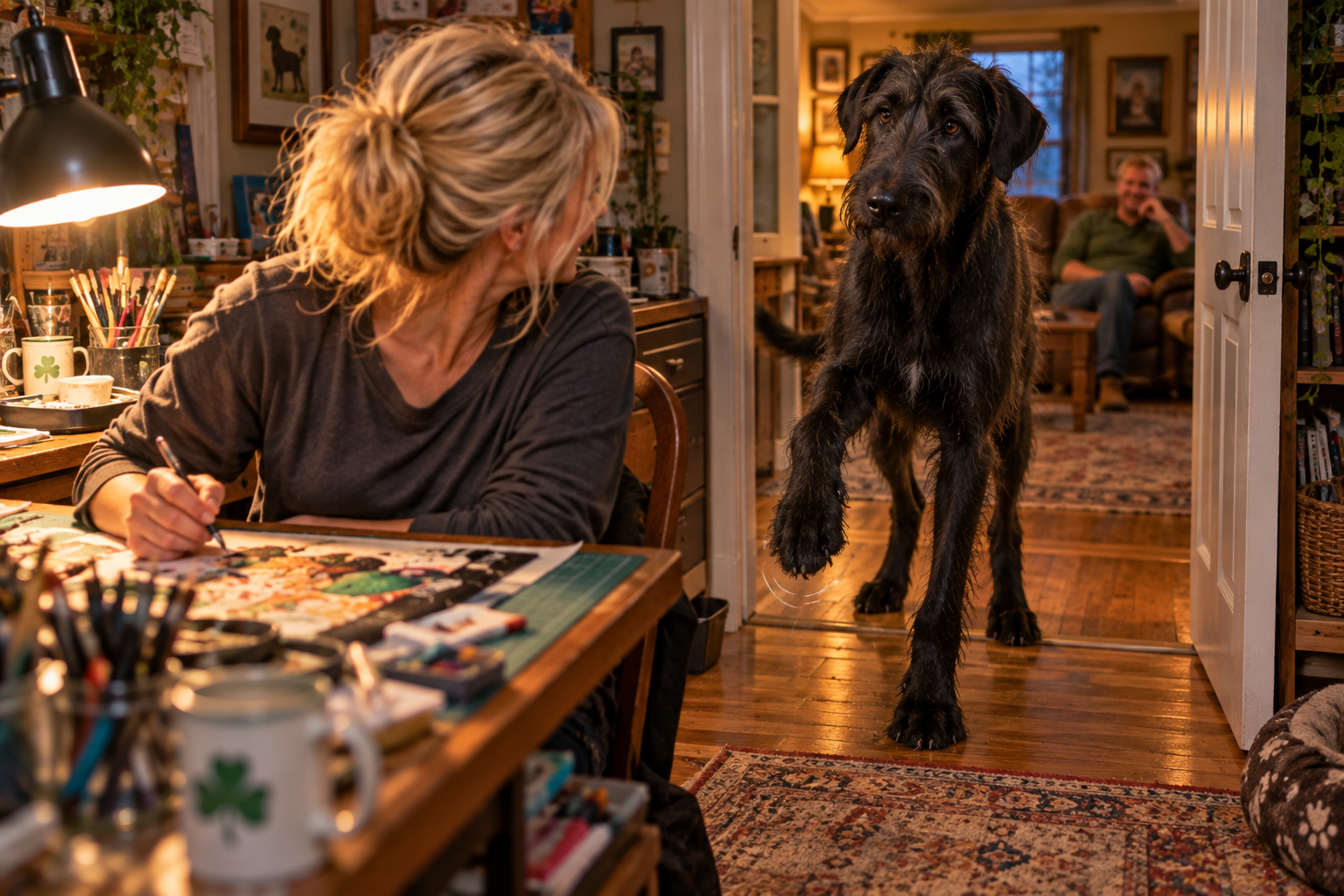
The Christmas piece was still clipped to the board, the holly unfinished. One corner shaded, the other left bare. The lamp above the table cast the same steady circle of light it always had, but the room beneath it felt different. Quieter. As if something large had stepped out and taken up all the oxygen with it.
It has been 16 months since I truly worked at my art table.
After our Irish Wolfhound Shamrock died, the studio changed. I tried to come back more than once. I would sit down, adjust the pattern, pick up a pen. Ten minutes later I’d be standing in the doorway again, unable then to explain why I couldn’t stay. The tools were where I left them. The chair fit the same way. But the room felt heavy, full of something I couldn’t move through.
For two almost three years, when I worked in there, Shamrock had a routine. He would decide—long before I did—that I was finished.
First came the head: that massive block of bone and softness resting squarely on the edge, eyes wide, tail sweeping the floor, staring at me as if willing me to notice him. If I ignored it, the ears would square forward. A slight tilt. A recalculation. Then came the punctuation: the double stomp. The huff. The head toss. That was the end of my studio session.
I thought I’d never experience the stomp again. That belief — that it ended with him, that the gesture, the presence, the routine was gone forever — was heavier than any unfinished piece. The pain of loss, wrapped up in the certainty of “never again,” was too much to bear.
Over the weekend, I packed the Christmas piece away. Not discarded — just gently set aside. I pulled a different piece from its box instead. One I planned to submit to the county fair this year.
I didn’t announce it. I didn’t make it a moment. I set it up and waited a few days.
When I finally sat down at the table, Justin walked past the doorway. He didn’t say much — just nodded. He had never pushed me to return to the studio. He knew I would go back when I was ready. He had missed seeing me there, but he gave me the time I needed.
I didn’t know if I would be able to stay.
But I did.
And something unexpected happened. The heaviness wasn’t there. The sadness that had lived there didn’t rush back in. I wasn’t bracing. I was working. I adjusted the pattern. Made creative changes. Smiled. I even started to sing under my breath. I wasn’t thinking about loss. I was absorbed in the piece, shaping it into something that felt like mine.
Then I felt Clover near the door. She is our one year old Irish Wolfhound - Shamrock's half sister. She didn’t enter the room. She simply stood there. I glanced at her and went back to work.
The bark came — loud, sharp, commanding. It startled me enough that I dropped my pen. I didn’t look at her. I picked it up and continued. I knew she was still there.
Then came the stomp.
It stopped me. Not because I thought it was mystical. Not because I imagined anything beyond what was happening in front of me. But because in all her 9 months with me, Clover had never done that before.
Not once.
I looked up from my painting. Her ears forward. Body still. Watching me. The emotion rose fast — warm, not heavy. A tear slid down and I laughed.
And she answered with the full double stomp dance and head toss.
From the family room, Justin shifted in his chair. He knew that sequence. At the first stomp, his posture changed. When I laughed and she doubled down, he gave that sideways, knowing smirk. He understood the significance without saying a word, and he let us have the moment.
Clover is entirely her own character — dramatic, brilliant, and still very much in her bitey goblin era.
But Wolfhounds carry certain gestures in their bones. A stance. A presence. A way of managing their people. They do not suggest. They conclude.
The stomp does not belong to one dog. It belongs to the breed.
In that room — the one I had avoided for 16 months — it didn’t pull me backward. It met me where I was. Creative. Peaceful. Present.
When I stepped out to her, she sealed her victory by chomping my arm in celebration, as if to remind me that whatever solemn meaning I might try to assign to the moment, she had simply come to collect her person.
From the family room, Justin’s chair shifted again — that small, knowing sound of life continuing in the next room.
The studio no longer felt like a place that held absence. It held history. Routine. Inheritance. Me.
And as Clover stood square in the doorway — ears forward, satisfied — I understood something steady and uncomplicated: the room had not been taken from me. I had simply needed time to walk back into it.
The studio was mine again