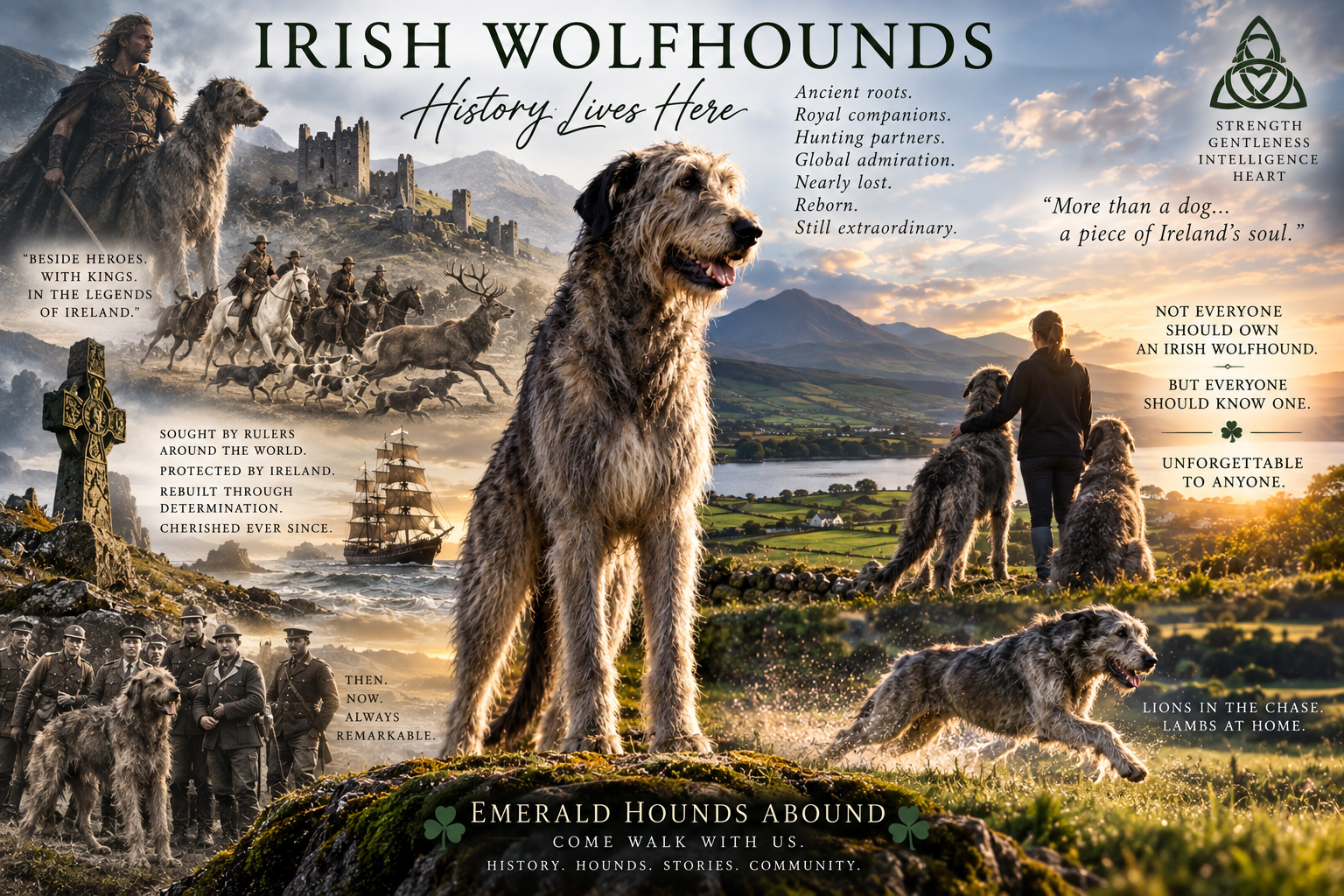
HOUNDS OF HISTORY & LEGEND
Why This Breed?
There is something about an Irish Wolfhound that makes people stop.
We know because we have watched it happen.
People stop us on sidewalks. They roll down car windows to shout questions and greetings at the dogs. They follow us through PetSmart, Lowe’s, Home Depot and garden centers, sometimes for several aisles, pretending they are not following us at all.
We see you. You are not fooling anybody. 😂
Some people are hesitant because of the size. Others are trying very hard to maintain the appearance of someone far too cool to become ridiculously excited over a dog, while behaving exactly like a child who has just discovered what is waiting under the Christmas tree.
One man followed Shamrock around Home Depot for so long, acting so strangely and obviously wanting to come closer, that eventually there was nothing left to do but invite him.
“You can come over. He won’t eat you. Well, today, anyway.”
People take pictures. Some ask first; some attempt to sneak them. People want to be in the pictures. Groups form around us, and sometimes actual lines form, everyone waiting to touch the dogs, ask questions, hear about them and get a photograph.
We have watched people nearly run us over in parking lots because they were staring at the Wolfhound instead of where they were driving. People have stopped running cars, gotten out in their excitement to meet the dogs, forgotten to put the car in park—and then had to run after their own vehicle.
Apparently an Irish Wolfhound can temporarily interfere with executive functioning.
At a park, we encountered a group of bikers having a party. Two big biker guys spotted Clover and Hooligan and walked away from their families and their “brothers” because there were Wolfhounds over there and priorities had apparently changed. Another time, a woman stopped her car in the middle of the road, traffic behind her, got out and came over because she had seen Clover and Hooligan walking.
Then there are the people who finally walk away clutching the photograph they just took, already announcing, “My wife is going to be so pissed she missed this.”
It is funny, but it is also not particularly new.
In A.D. 391, the Roman statesman Quintus Aurelius Symmachus wrote to thank his brother for seven great dogs sent from Ireland for the Roman games. He reported that all Rome viewed them with wonder.
More than sixteen centuries later, somebody is chasing his rolling car across a parking lot because he saw one. Humanity has apparently made remarkably little progress in maintaining its composure around Irish Wolfhounds.
The interesting question is why.
Why did ancient people prize these hounds? Why was ownership associated with rank? Why did kings, nobles and rulers in other countries specifically request them, and why did Ireland eventually have to stop people from taking them away? Why did people fight to preserve the hound after the animal it was famous for hunting disappeared?
Why reconstruct it when it became desperately scarce, carry it through wars, and continue the work today despite serious health problems and painfully short lives? And why, after all these centuries, does one walk into Home Depot and make everybody lose their minds?
To answer that, we have to meet more than the enormous dog.
We have to meet the Irish Wolfhound.
Before There Was an Irish Wolfhound
The modern Irish Wolfhound did not walk unchanged out of ancient Ireland with a pedigree tucked underneath one enormous paw. The history is much more complicated than that.
Names changed. Dog populations changed. Written records are incomplete, and history became tangled with mythology, poetry, folklore and later romantic retellings. Some claims repeated in breed literature for generations are difficult or impossible to prove.
What is unmistakable is that Ireland became famous for great hunting hounds long before the modern Irish Wolfhound existed as a registered breed. Classical writers knew of the great Celtic dogs, and by the fourth century dogs from Ireland had acquired enough of a reputation abroad that seven of them arriving in Rome could cause a sensation.
That matters because the ancient world already had large dogs and hunting dogs. The Irish hound was not remarkable merely because somebody had discovered how to make a very tall canine.
Its value lay in a more unusual combination: size and strength joined to speed, endurance, courage and independent intelligence. More importantly, all of those qualities had to exist in the same animal and work together.
To understand why, we have to understand what these dogs were expected to do.
A Hound You Had to Be Somebody to Have
In early Irish society, rank mattered enormously. Status affected rights, obligations, property and privileges, and the great hounds existed within that world.
Historical descriptions of Ireland’s native legal and social system associate ownership of valuable hounds with rank. Kings and nobles could keep them, and the number of hounds a person was entitled to maintain could reflect status. Ireland’s elite professional poets and learned classes also occupied privileged positions within that structure.
These were not simply expensive pets reserved for the rich because rich people enjoy owning impressive things—although, judging by human history, that probably didn't hurt. 😂 Their value came from what they could do.
Hunting required land, resources, horses, handlers and access to game. Maintaining very large dogs required food and considerable expense. These particular hounds were associated with formidable quarry: deer, boar and wolf. They hunted animals that could run, turn and fight back.
A dog capable of doing that work represented wealth and prestige, certainly, but also genuine capability. He had to possess enough size and power to matter when he caught something dangerous without becoming so massive that he could no longer catch it.
That balance would shape the hound for centuries.
The Hound Kings Asked For
The great Irish hounds became prized far beyond Ireland.
Calling them “gifts” can make the practice sound almost quaint, as though Irish nobles occasionally wrapped a giant puppy in a bow and sent it to somebody for Christmas. The surviving history is much more interesting.
Powerful people sought these hounds through political and aristocratic connections. They requested dogs and bitches, wanted breeding pairs, and sometimes specified particularly large specimens. The hounds were valuable enough to move through networks of kings, nobles, diplomats and courtiers.
In the 1590s, Henry IV of France asked the Earl of Essex to obtain Irish hounds for him. He did not simply want one impressive dog; he wanted a dog and a bitch—a breeding pair. Henry was an enthusiastic hunter, and the usefulness and reputation of the Irish hound had traveled far enough that a king wanted not merely to possess one, but potentially to produce more.
A few decades later, another surviving letter gives us an almost wonderfully modern glimpse into the demand. In 1623, Lord Deputy Falkland wrote to the Earl of Cork because Scottish noblemen wanted Irish dogs and bitches “of the largest sort.” The dogs were intended as gifts for princes and other nobles.
And, if possible, they wanted them white.
Apparently even in 1623 someone was saying, Yes, yes, enormous legendary Irish hunting hound. But what colors do you have? 😂
The reputation traveled far beyond the British Isles and continental Europe. At the Mughal court in India, Emperor Jahangir expressed interest in tall Irish hunting hounds in discussions involving the English ambassador Sir Thomas Roe.
Consider what that means. There were no photographs, television, international dog shows livestreamed around the world or airplanes capable of carrying a puppy across continents in hours. Yet the reputation of Ireland’s great hounds traveled far enough that powerful people thousands of miles away knew about them and wanted them.
Other giant breeds and types existed. What distinguished the Irish hound was not one exaggerated characteristic, but the combination of substantial size and strength with the construction and athletic ability of a coursing hound.
That combination existed because of the work.
“Bred to Hunt Wolves” Doesn't Tell You Nearly Enough
Nearly every short description of the breed eventually gives you the same sentence:
The Irish Wolfhound was bred to hunt wolves.
True.
Also spectacularly inadequate.
Because it leaves out the interesting part: How?
Many hunting dogs locate quarry, track it, flush it, tree it, corner it or hold it until the hunter arrives. A great hound used against wolves and other dangerous quarry needed a different collection of abilities.
Wolf hunting itself could take different forms depending upon place, terrain and period. Wolves could be tracked, driven, intercepted, trapped or pursued. Historical accounts even describe organized wolf-hunting establishments using different kinds of dogs for different work.
A seventeenth-century Irish lease requiring the maintenance of a wolf-hunting establishment listed Wolfdogs, English Mastiffs and other hounds separately. The Wolfdog wasn't simply the generic large dog in the group. He had a particular role.
Whatever the exact circumstances of an individual hunt, a hound expected to pursue and ultimately engage dangerous quarry eventually had to close the distance.
The wolf did not politely surrender because a large dog had arrived. Neither did boar or the great deer hunted by coursing hounds. These animals could run, turn, strike, gore, bite and fight for their lives.
The hound had to reach them, and once he did, he had to know what to do. There was no human standing beside him issuing a sequence of commands: Left paw. Now duck. Move right. Watch the teeth.
Those decisions were happening at speed. The hound had to make them.
The Mind Was Part of the Hunting Equipment
Independent intelligence was not an interesting bonus in a coursing hound. It was part of the equipment required to do the work.
A hound pursuing quarry across open country could be well ahead of the humans. Terrain changed. Quarry changed direction. Other dogs moved. Hazards appeared. The animal being pursued could suddenly turn and fight. The hound could not continually look back for instructions; he had to take in information, assess what was happening and act.
That kind of intelligence is sometimes misunderstood in the modern dog world. Irish Wolfhounds are occasionally described as difficult to train, stubborn or less intelligent than breeds known for rapid, highly responsive obedience.
There are two very different ideas tangled together there: intelligence and obedience are not the same thing.
Intelligence involves learning, understanding, assessing and solving problems. Obedience describes a dog's willingness to respond to what a person asks. One does not prove the other, and judging the intelligence of a hound by how quickly or repeatedly he performs a requested behavior tells us very little about the kind of thinking his working ancestors actually needed.
Yet we haven't experienced our Wolfhounds as disobedient either. Shamrock, Clover and Hooligan have generally done what we've asked them to do. Asked is the word we use deliberately. Our relationship with them isn't built around demanding compliance. We ask, and overwhelmingly, they answer by doing.
A close bond matters. When that relationship exists, the hound wants to cooperate with the person beside him. Independence and cooperation are not opposites. The historic coursing hound needed to make decisions for himself when no person was close enough to tell him what came next, while also living and working in partnership with humans.
When one of our dogs doesn't do something we've asked, our first conclusion isn't that the dog is being difficult or disobedient. There is a reason, and our job is to figure out what it is. Perhaps we haven't communicated clearly. Perhaps the dog is uncertain, distracted or uncomfortable. Something in the environment may matter to him that we've failed to notice. Labeling the behavior tells us very little; understanding its cause tells us something useful.
Shamrock gave us one particularly memorable lesson in that during agility.
At the time, he stood about 36 inches at the shoulder. The tunnel was only about 24 inches high. To get through it, he would have had to compress that enormous frame by nearly a foot, crouch low and almost crawl.
He was willing to investigate. He lowered himself enough to put his head inside, examined the proposition and came back out.
No thank you.
I, however, was not quite ready to abandon the idea.
What followed involved an extraordinary amount of encouragement, repeated trips through that tunnel on my own hands and knees, actual blisters, and an increasingly ridiculous attempt to convince a giant coursing hound that squeezing himself into a two-foot-high tube was tremendous fun. At one point, I was on all fours wagging my imaginary tail so enthusiastically that I knocked myself over.
Things deteriorated from there. 😂
The full story of Shamrock's agility career—and what happened next—is elsewhere on EHA in Ma’am, I Am a Legend, Not a Noodle.
What matters here is that the tunnel wasn't typical of his response to agility. He happily tackled other obstacles. The broad jump might as well have been made for that enormous stride, while the A-frame became a mountain Shamrock was delighted to conquer.
The tunnel was different, and eventually, I accepted his answer.
Built to Catch What Could Run Away
The Wolfhound’s mind made sense for the work. So did the body.
Stand beside an Irish Wolfhound and the first thing most people notice is the height. Watch one truly run and you begin to understand the animal.
The Irish Wolfhound is a sighthound, not simply an enormous heavy dog on very long legs. The breed standard reflects a difficult balance: tremendous size and power without sacrificing activity, speed, symmetry and grace.
The quarry could run, so the hound had to be able to catch it. The historic hound also worked in a mounted hunting world. Humans could cover serious distances on horseback, and the dogs needed enough speed and endurance to travel and course beside horses over substantial ground. A dog capable of one spectacular sprint but unable to continue would not have been terribly useful.
That work required reach, lung capacity, heart, strong hindquarters, a deep chest, powerful musculature and a body capable of gathering and extending at speed. Feet and limbs had to withstand enormous forces, while the hound still needed enough substance to handle what could happen when the pursuit ended.
Make him too heavy and you lose the runner. Make him too slight and you lose the power.
The result is the balance at the center of the breed: power and swiftness.
Until You See One Run
There is a moment in the gallop when the enormous animal seems to fold into himself. The hind legs drive forward beneath the body, the spine flexes and everything gathers. For an instant, the hound looks like a giant coiled spring.
Then it releases.
The body extends, the front reaches, the hindquarters drive, and an animal that looked enormous standing still suddenly begins eating the ground.
If you've only seen an Irish Wolfhound walking politely at the end of a leash, you have seen only part of the animal. Every once in a while, we get to see the whole machine open up.
It is breathtaking and, when all that power is coming directly toward you, slightly terrifying.
There is a point when every survival instinct you possess begins offering the same advice: MOVE.
You don't. At least not with the ones who know what they're doing.
Shamrock knew. Clover knows now.
You hear the breathing and feel the pounding through the ground as they approach. When they turn, sod tears loose and flies behind them. The distance disappears astonishingly quickly, and they are still coming. You become absolutely certain that you have made a terrible error in judgment.
Then, at what feels like the last possible instant, there is the smallest adjustment. Not a dramatic skid or a huge turn; just a tiny shift in trajectory. The rough coat can pass close enough to brush your body. You feel the wind the hound rode in on, then the rush he leaves behind.
And he's gone.
You stand there thinking:
OH. MY.
That control develops with maturity. Shamrock developed what we jokingly called “steering” before he acquired truly reliable brakes, and Clover did the same. Only within the last several months has she developed both to the point where those breathtaking close passes have become part of watching her run.
Hooligan is currently 125 pounds. He has the engine; steering and brakes remain on backorder. He runs into damn near everything, and whatever happens to be in front of him becomes the braking system.
He is essentially a rapidly expanding projectile with feelings, racing around as though he pays his own veterinary bills.
He does not. 😂
We remain amazed that he has not broken his neck. Even that adolescent chaos, though, tells us something about the modern Wolfhound: the body arrives extraordinarily quickly. Learning to operate all of it takes time.
Lions in the Chase, Lambs at Home
And then that hunting animal came home.
That may be one of the most remarkable parts of the breed. The hound capable of pursuing and confronting dangerous quarry also lived with people, families and children. He came back to the hearth.
The old description survives:
“Lambs at home, lions in the chase.”
That duality is central to the Irish Wolfhound. The power is enormous; the need to demonstrate it constantly is not.
A hound that large could not have been safe in a household if indiscriminate aggression were part of the package. Judgment mattered in the field, and temperament mattered at home. The same animal that could confront dangerous quarry could return to family life and lie beside the children in front of the fire.
Another traditional phrase captures the same balance:
“Gentle when stroked, fierce when provoked.”
Wolfhound people have been trying to describe that quality for generations: power without constant threat, courage without indiscriminate aggression, and gentleness without weakness.
We still catch glimpses of it in the modern hound.
Guard Dog? Not Quite.
Irish Wolfhounds are not generally conventional guard dogs. Most are not spending the afternoon patrolling the perimeter hoping someone gives them an excuse to deploy.
Their size handles a remarkable amount of deterrence all by itself. An adult Wolfhound doesn't necessarily need to bark. Sometimes he simply has to stand there. There is something remarkably persuasive about a huge, silent hound watching you from the other side of a gate.
But many Wolfhound people describe something different when the hound believes his person is genuinely threatened. The word guardian sometimes fits better. Perhaps sentinel is better still.
The change can be quiet. The hound watches, assesses, positions himself and waits. Rather than sounding an alarm simply because a stranger exists, he places that enormous body where he believes it needs to be.
We saw it with Shamrock on a secluded trail when four unfamiliar men approached. He didn't lose his mind because men existed, nor did he decide everyone approaching us was dangerous. He watched and assessed, then positioned himself and held the line.
This far. No farther.
When one of the men crossed the boundary Shamrock had apparently established, he gave a low warning huff. That was enough. There was no charge, no hysterical barking and no unnecessary escalation. The power was available; Shamrock decided how much of it was necessary.
The full encounter has its own place among the EHA stories. Here, it matters because it gave us a living glimpse of the judgment people have long valued in these dogs.
And Then There Was the Bear
Sometimes we catch another glimpse of that same judgment.
A bear once wandered onto our property. Two other dogs were already going nuts, and the bear did not care.
Then Shamrock arrived.
Two deep barks and Shamrock's presence were apparently enough for the bear to reconsider every decision that had brought him to that moment. He NOPED right off the property.
Shamrock watched him go.
We aren't telling the bear story here; the full story is elsewhere on EHA. What interests us here is the contrast. Noise alone hadn't mattered. Then the enormous hound arrived, assessed what was standing in front of him and announced himself twice.
The bear made a decision, and Shamrock had no reason to pursue the matter further.
We cannot look at a modern pet and claim that one backyard encounter somehow recreates an ancient wolf hunt. It doesn't. But when you know what generations of these hounds were selected to be, moments like that make you look twice.
The Hound of Heroes
History tells us what people did with the great hounds. Legend tells us something different: what the hounds meant.
Irish mythology did not leave them standing quietly in the background. The hounds appear beside heroes, warriors and kings.
The great hero Cú Chulainn takes his famous name from a hound. In the traditional story, the boy Setanta kills the formidable watchdog belonging to Culann and offers to take the hound's place until another can be raised. He becomes Cú Chulainn—the Hound of Culann.
Fionn mac Cumhaill is inseparable in the Fenian tradition from his extraordinary hounds Bran and Sceólang. The celebrated hound Ailbé becomes the object of competing claims by powerful rulers in The Tale of Mac Da Thó's Pig.
These are legends, not pedigrees. That's precisely why they matter.
A culture does not repeatedly place an animal beside its heroes by accident. The hound became part of the language people used to talk about courage, loyalty, nobility, war, hunting and Ireland itself.
The great hound had escaped the kennel and entered the imagination.
The Wild Stare
There is another piece of Wolfhound lore that is difficult to explain until you experience it: the Wild Stare.
A Wolfhound can spend the morning doing something so spectacularly stupid that you wonder whether the independent intelligence we just praised was perhaps misplaced.
Then he looks at you.
The rough brows frame the eyes, and something changes. It isn't ordinary eye contact. For a moment the goofy dog seems to disappear, replaced by an expression that feels old, remote, knowing—almost as though something from very far away has briefly looked out through the modern dog.
You can dismiss the language as romantic until a Wolfhound gives you the stare. Then you begin to understand why people who know these dogs keep reaching for words that sound too large.
One of those descriptions is:
More than human.
Not human. Not pretending the hound is a person. Something else—something distinctly Wolfhound.
Perhaps that is part of why these animals moved so easily into legend. Sometimes they look as though they remember it.
When Ireland Had Too Few Hounds
The great hounds were prized beyond Ireland. Perhaps too prized.
For centuries, desirable Irish hounds traveled abroad through aristocratic and diplomatic networks while Ireland itself still had wolves. Eventually the demand created a practical problem.
In 1652, authorities prohibited the export of the great Wolfdogs because wolves were increasing and damaging livestock while the dogs useful for destroying them were being carried out of the country. Customs officials were instructed to seize hounds being exported.
Consider what had happened. A dog associated with rank at home had become desirable enough that foreign rulers and nobles sought it, breeding pairs were requested and the reputation traveled enormous distances. Eventually Ireland had to intervene because too many useful hounds were leaving.
Essentially:
Stop taking our dogs. We still need them.
That may be one of the greatest compliments ever paid to a working breed.
It was also a warning. The great hound was becoming scarce.
When Did Everybody Else Get to Have One?
There was no single glorious morning when Ireland announced:
Good news, peasants! Wolfhounds for everyone!
😂
The answer is much more interesting because the world around the hound changed.
The old Gaelic political and legal order weakened and eventually collapsed. English political control and law expanded. Landholding changed, as did hunting and the methods used to destroy predators. The social structures that had once tied possession of great hounds to rank no longer operated in the same way.
Eventually Ireland's wolves disappeared. The date traditionally associated with the last Irish wolf is 1786, although claims about the absolute “last” wolf should always be treated cautiously. By the late eighteenth century, however, the wolf was effectively gone from Ireland.
That should have been good news for people who had spent centuries trying to protect livestock. For the Wolfhound, it created an existential problem. The animal had lost the work that helped create him just as the society in which he had once occupied a privileged place was changing around him.
The great hound now faced an enemy much more dangerous than the wolf:
Irrelevance.
Numbers declined. By the nineteenth century, the old Irish hound had become so scarce that some writers believed it had disappeared altogether.
The world no longer needed him, but some people refused to let that be the end of the story.
What Were They Actually Trying to Save?
The nineteenth-century revival of the Irish Wolfhound is often reduced to a few sentences: the breed almost went extinct, Captain George Augustus Graham found surviving dogs, other breeds were crossed in, Irish Wolfhound restored.
That skips the most interesting question.
What were they trying to preserve?
If the objective were simply to manufacture an extremely large dog, Victorian Britain already had extremely large dogs.
Men including H.D. Richardson had argued earlier in the century for the survival or recovery of the old Irish hound. Later, Graham devoted decades to gathering animals he believed carried remnants of old Irish strains and to building a recognizable, reproducible type.
The surviving population was too small and inconsistent to simply close the breeding population and proceed, so other blood entered. The breeds used tell us something about what these men believed the Irish Wolfhound needed to be.
The Scottish Deerhound was fundamental. That makes immediate sense: the Deerhound was a rough-coated coursing sighthound built to pursue large quarry and closely resembled the general kind of animal Graham believed the Irish hound had been. Graham's own ideal was essentially a taller, heavier and more massive hound of that general form.
More size and substance were needed, and Great Dane ancestry entered through dogs from lines containing Dane crosses, contributing height, bone and mass. Borzoi blood also entered the developing breed—another great coursing sighthound with a history of pursuing large quarry, including wolf. There was also a limited outcross involving what Graham described as a Tibetan Wolfdog or Great Dog of Tibet.
This wasn't a nineteenth-century canine blender.
One scoop Deerhound. One scoop Dane. Add Borzoi until fluffy.
😂
They were trying to recover a particular kind of animal: a rough-coated hound with the coursing construction and speed to pursue quarry, the height and strength to confront it, the movement and athleticism to remain functional, and the courage and presence described in the old accounts. Ultimately, those characteristics had to become stable enough to reproduce a recognizable type generation after generation.
What they were trying to recover was balance.
Make the hound too heavy and you lose the runner. Make him too slight and you lose the power. Chase height for height's sake and you can sacrifice soundness. Create aggression without judgment and you have lost the temperament. Lose the independent mind and you have changed the working character.
You might still have an enormous dog, but you would not necessarily have an Irish Wolfhound.
When the Irish Wolfhound Club was established in 1885 and the developing breed received a formal standard, that balance was written directly into the ideal: great size and commanding appearance, certainly, but also power, activity, courage and symmetry.
The goal was not simply the largest dog possible. The goal was the hound.
Saving Him Once Wasn't Enough
The revival succeeded, but survival was hardly guaranteed.
The First World War devastated people, kennels and breeding populations across Europe. Wolfhound breeders kept the breed going, only to face another catastrophe when the Second World War brought scarcity, disruption and another contraction in the population.
Maintaining enormous animals that consumed enormous quantities of food was hardly the most practical wartime hobby imaginable. Yet people did it.
After the war, American Wolfhound blood was sent back across the Atlantic to help British breeding programs recover and broaden their options.
By then the hound had survived the disappearance of his original work, a dangerously small population, deliberate reconstruction and two world wars. At several points, allowing the breed to disappear would have been easier.
People kept choosing otherwise.
The Hound Still Walks With Soldiers
One of the loveliest continuities in the modern history of the breed is that the Wolfhound still walks with soldiers.
In 1902, an Irish Wolfhound became the first official regimental mascot of the Irish Guards, beginning a tradition that continues today. The regimental hounds bear names drawn from Irish kings and legendary chieftains and appear at important ceremonial occasions, including the famous St. Patrick's Day presentation of shamrock. The Royal Irish Regiment also maintains a Wolfhound mascot tradition.
There is something wonderfully fitting about a hound whose ancient history and mythology are tangled with warriors, kings and chieftains still walking ceremonially beside soldiers.
The world changed. The role changed.
The hound still belongs there.
The Modern Wolfhound Is Still History
It is tempting to finish breed history somewhere around the nineteenth-century revival, as though everything after that is merely pet ownership.
It isn't.
The history of the Irish Wolfhound is still being written, and some of the greatest challenges the breed has ever faced are modern ones.
Start with the sheer act of building one.
Building a Giant
Wolfhound puppies begin life at roughly the size you might expect from puppies.
That condition does not last long.
A newborn may weigh around a pound. By the time a Wolfhound puppy is ready to leave a responsible breeder—generally around 10 to 12 weeks—he may already weigh somewhere in the neighborhood of 25 to 30 pounds, with individual variation. The acceleration continues, and around six months a Wolfhound may be approaching 100 pounds.
Think about what the body is accomplishing. A puppy that began around a pound may construct the equivalent of an entire large adult dog in roughly half a year—and still have a great deal of growing left to do.
Living with that kind of growth is surreal. We joke that if the house is quiet enough, you can actually hear the bones stretching.
There are times when we are completely serious when we say a puppy went down for a two-hour nap and got up looking bigger.
Wasn't that leg shorter when you fell asleep?
Wolfhound puppy: No comment. 😂
Shamrock gave us a particularly vivid demonstration shortly after he came home. He discovered the small cat opening in a gate and went straight through it—whole puppy.
The cats were not pleased that their private entrance had apparently become the Shamrock Express.
We closed it.
About six days later, the problem solved itself. Shamrock didn't fit anymore, so the cats reclaimed their door. Eventually his adult muzzle wouldn't have fit through the opening he once used for his entire body.
That is Wolfhound growth: funny to watch, extraordinary to contemplate, and medically important.
When the Body Arrives Before the Owner's Manual
A skeleton growing at that rate has an enormous job to do. Bones lengthen rapidly while joints develop under an ever-increasing load. Muscles, tendons and ligaments are trying to support a body whose dimensions seem to change by the week, and coordination has to keep pace.
Sometimes it doesn't.
We've watched our young hounds grow into their bodies at different rates. Shamrock developed what we called steering before reliable brakes, and Clover did the same.
Hooligan is currently 125 pounds of evidence that the engine can arrive considerably before either. He has no steering and no brakes. He runs into damn near everything, and whatever happens to be in front of him becomes the braking system.
He is essentially a rapidly expanding projectile with feelings, racing around as though he pays his own veterinary bills.
He does not. 😂
We remain amazed that he has not broken his neck. Even that adolescent chaos, though, tells us something about the modern Wolfhound: the body arrives extraordinarily quickly, while learning to operate all of it takes time.
This is not a scientifically established developmental timetable for Irish Wolfhounds. It is simply life with ours. Underneath the joke, however, is a serious point: a giant-breed puppy isn't merely becoming a larger version of yesterday's puppy. An extraordinary physical construction project is underway.
That is why knowledgeable Wolfhound people care about appropriate nutrition, body condition, sensible exercise, developing joints and sound structure. The goal is not to see how enormous we can make a puppy as quickly as possible; the puppy is perfectly capable of becoming enormous without assistance.
The goal is to grow a sound hound.
Hormones Are Part of the Story Too
Modern understanding of canine development has also complicated decisions that many people were once taught were simple. Spaying and neutering is one example.
Society has spent decades delivering an important message about preventing unwanted litters, and the number of animals still entering shelters and rescues demonstrates why responsible reproduction matters. But preventing irresponsible breeding and deciding when to alter a giant-breed dog are not necessarily the same question.
People ask us regularly whether our hounds are spayed or neutered. For many people, early altering is simply what responsible dog ownership has always meant.
Wolfhound people have had reason to look more closely.
Sex hormones participate in skeletal maturation. Removing them early can affect the timing of growth-plate closure, and research in dogs has raised concerns about relationships between early sterilization and certain orthopedic disorders and cancers. That matters enormously in a breed already undergoing extreme skeletal growth and facing a serious burden from diseases such as osteosarcoma.
This isn't an instruction from EHA about when anybody should alter a dog. Individual dogs and circumstances differ, and those decisions belong with owners, knowledgeable breeders and veterinarians familiar with giant breeds.
It is, however, part of modern Wolfhound history. Preservation changes as knowledge changes. Keeping the breed alive is no longer enough; the goal is to keep learning how to do it better.
The Price of Being Enormous
The very thing that stops traffic is also one of the modern Wolfhound's greatest challenges.
Enormous bodies are difficult bodies to build, maintain and keep healthy for a long time. Irish Wolfhounds face serious health concerns including osteosarcoma, heart disease such as dilated cardiomyopathy, gastric dilatation-volvulus—bloat and torsion—and other significant health problems. Their average lifespan is shorter than that of many breeds.
There is no point pretending otherwise. People who love this breed know the bargain can be brutal.
Perhaps the hardest question in the entire history of the Irish Wolfhound is therefore one we can ask right now: Why keep doing this?
Why continue breeding a dog whose enormous body can create enormous medical challenges? Why pour money and effort into heart testing, cancer research, genetic diversity, responsible breeding and longevity? Why spend years trying to improve health and soundness? Why bring home an animal when you know there is a real possibility that your time together will be painfully short?
Why lose one... and someday bring home another?
Because that is exactly what Wolfhound people do.
The modern preservation of the Irish Wolfhound isn't finished. The enemy simply changed.
Today's challenge is to preserve what makes the hound extraordinary while trying to give that hound a healthier, longer future: to retain size without worshipping excess; to preserve power, speed and athleticism alongside soundness; and to protect the independent mind, temperament and character that make the animal a Wolfhound rather than simply an enormous dog.
After centuries spent trying to keep the hound itself, perhaps the great modern challenge is deceptively simple:
Keep the hound—and give him more time.
Why Do We Keep Fighting for Them?
That question runs underneath this entire history.
The original work disappeared, yet people kept the hound. When the surviving population became dangerously small, people tried to reconstruct it. War threatened the breeding population more than once, and people continued anyway. Modern Wolfhound people now live with serious health concerns, short lifespans, expense, logistical insanity and the knowledge that loving one of these animals may eventually hurt terribly.
There are easier dogs. People still choose this one.
No single characteristic explains why. The extraordinary scale is part of it, certainly, but so is the body of a galloping athlete inside that giant frame. There is independent intelligence and judgment, sensitivity and gentleness, dignity and a spectacular capacity for absolute foolishness.
This is the hound that could close with dangerous quarry and return to the family hearth; the enormous animal who rarely needs to prove how powerful he is; the sentinel who watches and the companion who leans. He can look magnificent enough to lead soldiers on parade and ridiculous enough to forget how large his own rear end has become.
Shamrock could send a bear off the property with two barks and, at 210 pounds, behave as though imminent death from Blow Pop deprivation was a genuine medical emergency.
That, too, is the Irish Wolfhound. 😂
Then there is the Wild Stare and that strange sense, difficult to defend logically and equally difficult to dismiss once you've experienced it, that something very old is still looking out through those eyes.
More than human.
Perhaps that is why the hound kept escaping history and turning up in legend. Perhaps it helps explain why rulers wanted them, why people worked to preserve them after their original purpose disappeared, and why people who have already been shattered by losing one will willingly open the door to another.
Some animals are very difficult to let go.
This appears to be one of them.
And People Still Stop
Which brings us back to where we began: the woman in the road, the bikers at the party, the people stalking us through Lowe's, the running cars, the photographs, the lines, the questions, and the person trying desperately not to look excited while being extremely, painfully, hilariously excited.
We know there are Wolfhound owners who get tired of this. We understand why. There are only so many times a person can hear “Where's the saddle?” before wondering whether humanity has collectively agreed upon a single giant-dog joke and simply refuses to develop another one. 😂
Some owners cringe when they hear it.
We don't.
Justin and I expect the attention. More than that, we enjoy it and encourage it, as long as the hounds themselves are comfortable and enjoying the interaction.
Ask the question we've heard a hundred times. Make the saddle joke. Ask how much they weigh, what they eat, how old they are, whether they're really Irish Wolfhounds. Come close enough to discover what that strange rough coat actually feels like.
The question may be old to us, but the experience may be completely new to you.
That is something we try very hard to remember.
This Might Be Your One Wolfhound
That man behaving strangely around Shamrock in Home Depot may have been seeing his first Irish Wolfhound. Maybe Shamrock wasn't only his first; maybe he was the only Irish Wolfhound that man will ever meet in his life.
We don't know, but we feel a responsibility in that.
If one of our dogs is someone's first encounter with this breed, we want it to be a good one. If he's their only encounter, we want it to be an even better one.
That doesn't mean anybody is entitled to the dog. The hound gets a vote. Always. If Clover has had enough, she's had enough. If Hooligan is uncomfortable, tired or simply doesn't want to participate, the interaction ends. The dogs are living beings, not exhibits.
When they're happy to meet you, however, we want the people holding the leashes to be part of the good memory too. We want to be friendly and open, and we want you to feel comfortable asking questions even if we've answered them before. We get to live every day with animals most people will encounter only occasionally, if ever. Sharing a few minutes of that experience costs us very little and may give somebody a memory that lasts for years.
Maybe someday someone will mention Irish Wolfhounds and you'll smile and say:
“I met one once.”
We'd like to make that one count.
Why Emerald Hounds Abound?
That responsibility is part of why EHA exists.
EHA didn't begin because the world desperately needed another website telling people facts about dogs. It grew from living with these hounds, learning about the extraordinary history behind them, and realizing that the best way we can share that history is through the dogs who are still living it.
We are also not saying everyone should own an Irish Wolfhound. Quite the opposite, if pushed.
They are not for everyone, and that's okay. They're enormous and expensive. They grow at an almost absurd rate. Their health can be complicated and their lives can be terribly short. They require space, planning, commitment and a willingness to rearrange parts of your life around an animal who may eventually be able to look you directly in the eye while all four feet remain on the floor.
They can reach things you did not know were reachable. A young one may regard your landscaping as a braking system. They eat.
Good Lord, do they eat.
And when they leave, the hole can be enormous too.
No, not everyone should have one.
We have them. Come see ours.
You don't have to own an Irish Wolfhound to know one.
Spend time with them. Pet them. Walk beside them. Sit with them. Take pictures and get in the pictures. Watch Clover move. Watch Hooligan grow. Laugh at them and learn about them—not only what they were built to do and the legends that grew around them, but the difficult parts of keeping this breed in the world.
Maybe you'll leave thinking, That was incredible, and there is absolutely no way I should ever own one of those things.
Perfect. 😂
Maybe you'll follow their lives or care a little more about what happens to the breed. Maybe years from now you'll recognize an Irish Wolfhound walking toward you because once, somewhere, you knew Clover or Hooligan.
Maybe you'll never have one sleeping in your house or pay a Wolfhound food bill.
Lucky you.
Maybe you'll simply love them.
That's enough.
The One Thing We Cannot Put on This Website
We can give you the history. We can tell you about Rome, kings, wolves, heroes, warriors, reconstruction, regimental hounds and the people who refused to let the breed disappear. We can explain the body and describe the gallop. We can show you photographs and tell you about the Wild Stare.
There is one thing none of that can give you:
The hound himself.
We can describe the size, but it won't prepare you for standing beside one. We can tell you about the Wild Stare, but we cannot give it to you through a screen. We can tell you that people have marveled at these dogs for centuries, but Clover or Hooligan can walk toward you and let you discover why for yourself.
Perhaps that is the simplest answer to the question we began with.
Why this breed?
Come meet one.
Maybe you'll understand.
Maybe ours will be the first Irish Wolfhound you ever meet. Maybe the only one. Either way, as long as the hounds are enjoying themselves, you're welcome to walk with us for a while.
The Irish Wolfhound has spent centuries walking beside hunters, warriors, kings, families, storytellers and ordinary people who simply could not imagine a world without the hound in it. Now we get to carry a small piece of that story forward—and we would rather not keep it to ourselves.
Something ancient still walks with us.
Come see them. Learn about them. Feel small beside them. Laugh with them.
And maybe, without ever needing to own one, come love them.
Emerald Hounds Abound
Come Walk With Us. 🐺💚
Donations kindly accepted. Legends have to eat, after all. 😂