ANCIENT TEETH, GENTLE HEART
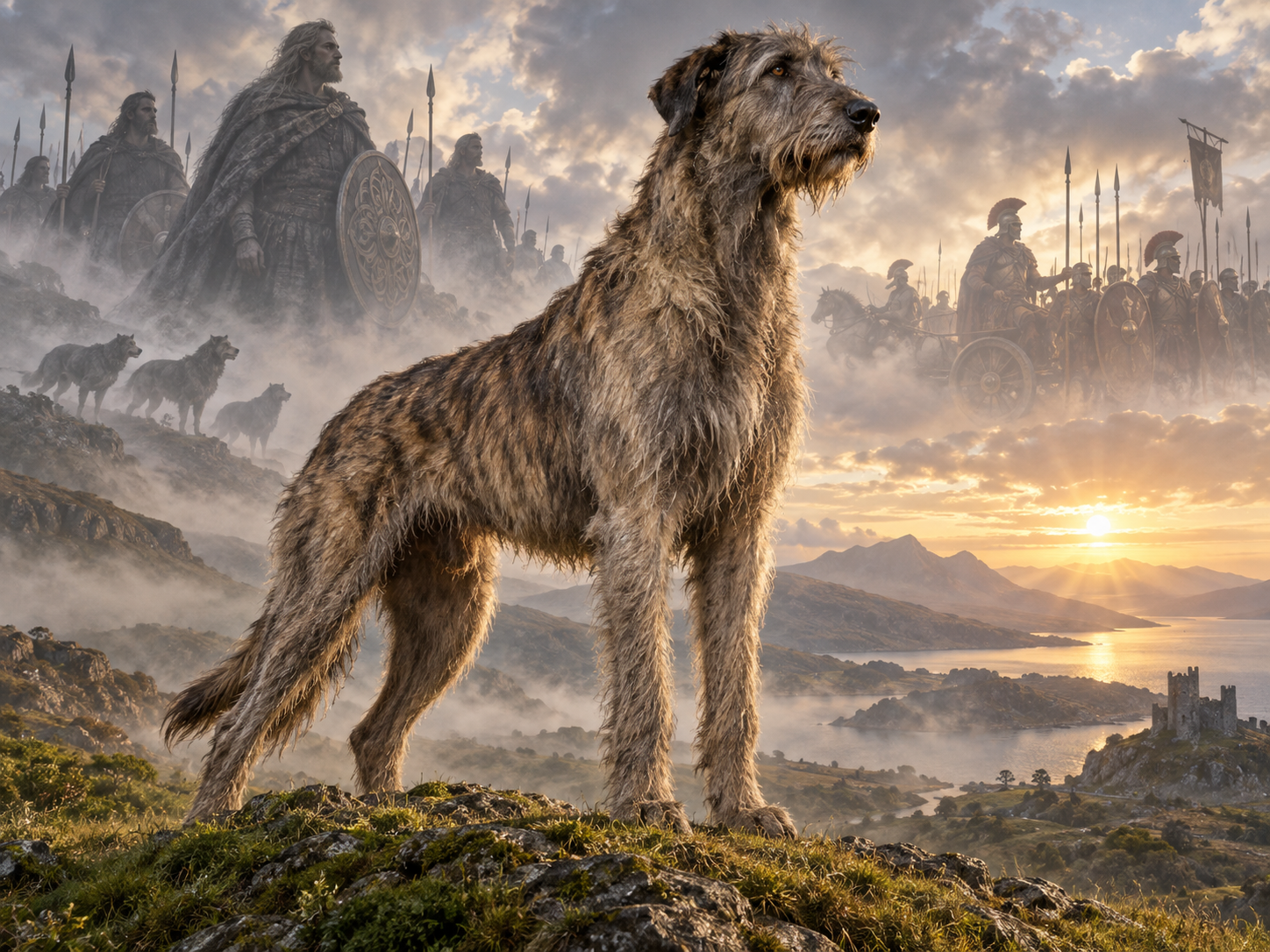
PART 1: LEGEND, LIVED
We always hear that modern Irish Wolfhounds are ancient —
with roots going back about 2,000 years.
But here’s the part most people don’t know:
They almost disappeared because they were too good at their job.
Irish Wolfhounds were bred to hunt and kill wolves — and over time, the great wolves of Ireland were wiped out.
Once the wolves were gone, the hounds were no longer needed… and their own numbers began to vanish too.
Long before that, these hounds were also used as war dogs by the Celts and later by the Romans.
They ran beside chariots and into battle, pulling armored soldiers from horseback and breaking formations — trained to bring down armored riders with swift, precise strikes, as easily as snapping a flower from its stem.
They didn’t corner prey and wait for humans to finish the job like many hunting dogs do. When hunting wolves, Irish Wolfhounds were expected to take the wolves down themselves.
Those powerful front legs we joke about as “thunderpaw” or “clobber paw” were once used to strike and destabilize wolves, breaking their backs or knocking them off balance.
The same long legs were used to trip large animals — and even horses in battle.
By the late 1800s, only about 400–700 true hounds were thought to remain.
With so few left, inbreeding became a serious threat — and the breed stood on the edge of extinction.
That’s when Captain George Augustus Graham, along with other devoted breed lovers, made a determined effort to save the Irish Wolfhound.
To rebuild the breed, they carefully introduced:
Great Danes,
Scottish Deerhounds,
Mastiffs,
and Borzoi (Russian Wolfhounds),
with possibly a small amount of Greyhound influence.
It’s important to understand what that rebuilding meant.
The ancient Irish Wolfhound was not lost.
The remaining hounds still carried the original size, structure,
temperament, and purpose described in Ireland’s oldest records.
Captain Graham and those who worked with him were not trying to create something new.
They were trying to save something very old.
The other breeds were used to strengthen a fragile population —
not to change what the Wolfhound was,
but to protect what it already had been.
They were preserving a type,
not inventing one.
So technically…
they aren’t the exact same dog as the ancient hounds of Ireland.
But they weren’t trying to save just DNA.
They were trying to save a type:
Tall.
Powerful.
Gentle with their people.
Built to guard and hunt.
They rebuilt the body —
and carried forward the spirit.
PART II — THE INSTINCT, NOW (My Turn)
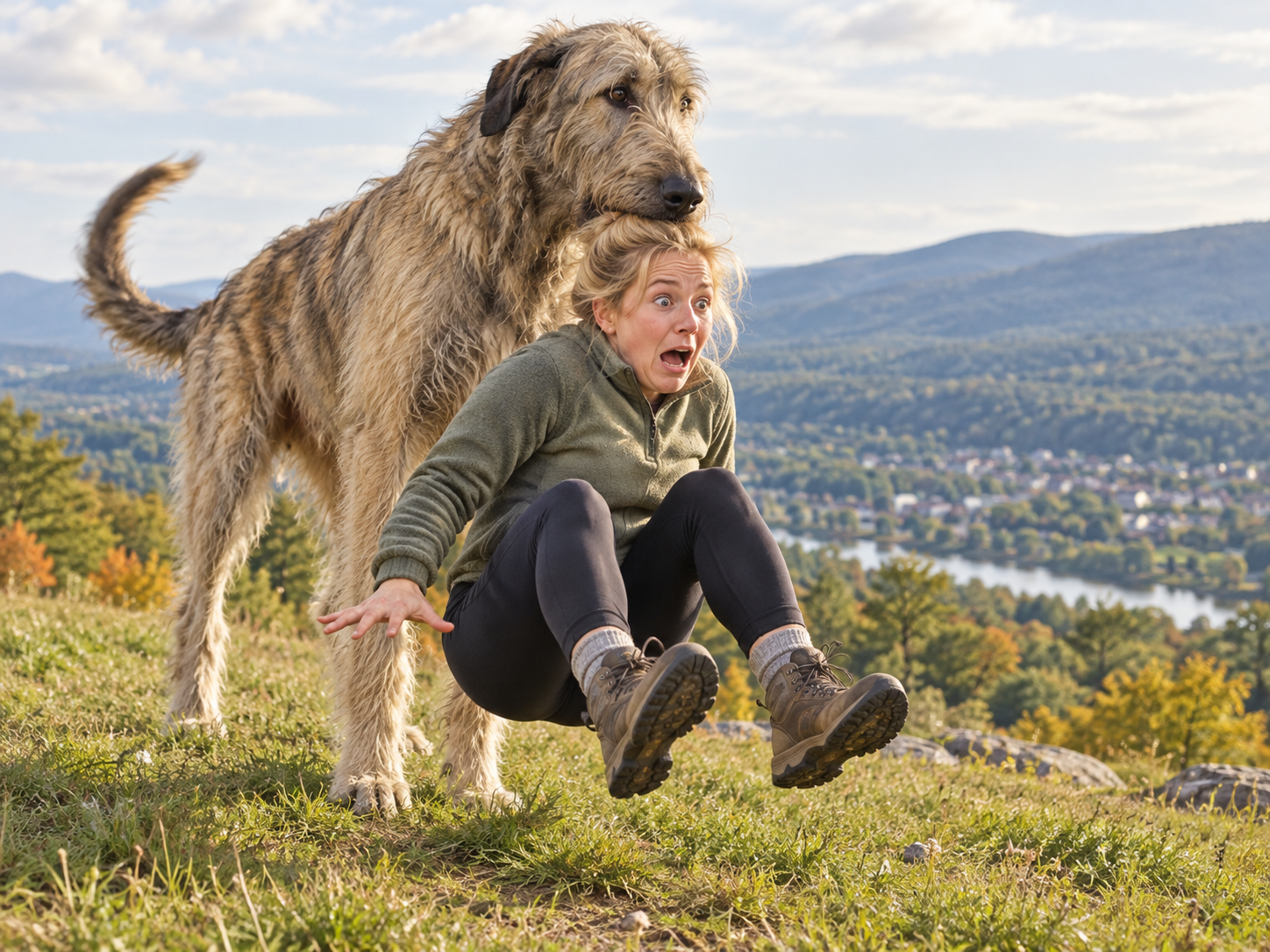
I was sitting on a hill in Ellenville when Shamrock came up behind me.
He was about two years old — that age when an Irish Wolfhound suddenly realizes:
Oh. I am… very large.
In one smooth motion, his mouth went all the way around my head.
Not biting.
Not snapping.
Just… pressure.
Gentle pressure.
Affectionate pressure.
But pressure all the same.
Every part of Shamrock was saying,
“I love you, tiny human, I will hold your head like a melon.”
My nervous system heard something else.
“SOMEONE MADE A TERRIBLE EVOLUTIONARY ERROR.”
I didn’t stand up…
I teleported.
One second:
sitting peacefully on a hill
Next second:
HUMAN ROCKET LAUNCH
That was a pure, primal,
“NOPE, I choose life” reflex.
My brain did not pause to consider intent.
My brain did not factor in love.
My brain did not care that this was my dog.
My brain said:
ANCIENT WAR HOUND JUST CHOSE YOU.
Later, I laughed about it.
But something else clicked too.
For 8,000 years, hounds like him were bred for a very specific purpose.
They didn’t circle prey and wait for humans to finish the job.
They were the job.
And here was Shamrock, centuries later, in a quiet yard in New York…
doing the gentlest version of what his ancestors were built to do.
Not in battle.
Not in war.
Not against wolves.
But against the back of my unsuspecting head.
And in that moment, I knew — in my bones — why:
Roman soldiers
Irish wolves
and invading armies
all went:
“Maybe… not that dog.”
It wasn’t aggression.
It wasn’t dominance.
It was instinct, softened by generations of living beside humans instead of charging into them.
A reminder that inside this sweet, goofy, couch-stealing giant
lived the blueprint of something ancient.
Something that once cleared battlefields.
Something that once hunted monsters.
Something that once changed the course of history.
And that day, sitting on a hill,
I didn’t just own a big dog.
I briefly met the ghost of a war hound
— and lived to tell the tale.
PART III — SHAMROCK REMEMBERS (His Turn)
I was two years old, and the world was very interesting.
I had recently discovered three important facts:
I was large.
My human was small.
My mouth could fit… a lot.
This seemed like valuable information.
My person was sitting on a hill in Ellenville, facing away from me.
Not guarding the rear.
Questionable tactical choice.
So I approached quietly, as any respectable war hound would.
I did not intend harm.
I intended… contact.
Very carefully, I placed my mouth around her head.
Not biting.
Not snapping.
Just applying a polite amount of pressure, like:
“Hello, little one.
You fit beneath my chin.
That means you are mine to protect.”
For one perfect moment, the universe made sense.
Then she vanished.
One second, head in mouth.
Next second, no head at all.
She went straight up like a startled deer.
I stood there, confused.
Had I done something wrong?
Had the head escaped?
Was this a game?
I wagged my tail to signal that this had been meant kindly.
Later, I understood something important:
For thousands of years, hounds like me did this to wolves.
To soldiers.
To things much larger than humans.
But I was not built for war anymore.
I was built for hills, and yards, and couch cushions,
and the person whose head fit so neatly inside my mouth.
What my ancestors did in battle,
I did in play.
What they used to unseat enemies,
I used to say hello.
I did not mean to summon history.
I only meant to touch my human.
But sometimes, when you are an Irish Wolfhound,
the old stories leak out through your teeth.
--------------
From war hounds and wolf hunters to couch giants and hilltop ambushes.
The body changed.
The world changed.
But the instinct never quite did.
Something ancient still walks with us.